1

The basic facts of economics — Inside the Classic
22
5
Project Gutenberg
2024
Economics
Readers of public-domain and historical texts
Project Gutenberg digital edition
en
Edition facts
Words: 31,670
Reading time: 138 min
Text sections: 15
Source:
Project Gutenberg record #73475
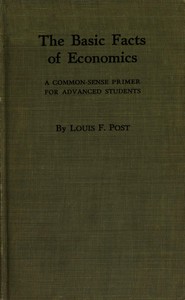
Louis F. Post's 1927 primer uses a common-sense approach to distinguish artificial objects (wealth) from natural resources (land) and legal titles, urging precise economic terminology through concrete examples like farms and mortgages.
Louis F. Post opens his 1927 primer by declaring that economics appears to be the science of making money, but quickly pivots to a more foundational concern: the precise classification of economic categories. He warns that colloquial usage lumps together artificial objects, natural resources, and legal titles under the single term “wealth,” leading to confusion. Post insists that only artificial objects produced by human exertion from natural resources qualify as wealth in the technical sense; natural resources belong to the land category, and titles like mortgages or stocks are mere evidences of ownership. This insistence on terminological rigor sets the stage for a methodical dismantling of common economic misconceptions.
A Farm as a Test Case
Post illustrates his core distinction by analyzing a farm. He notes that a farm is often called “wealth” or “capital” in everyday speech, yet it actually combines natural resources (the site, untilled soil, surrounding space) with artificial objects (buildings, fences, ditches, soil enrichment from tillage). A mortgage on the farm, he argues, is not wealth at all—it is merely evidence of a legal claim. To drive the point home, he offers a reductio: if mortgages were wealth, then a farm worth $10,000 would become worth $15,000 if mortgaged for $5,000, and $17,000 with a second mortgage of $2,000. This absurdity, Post contends, shows why precise economic terminology matters.
The Urban Building Example
Post extends his analysis to an urban residence or business building. The site, the enveloping atmosphere, and the space are all natural resources (land). The building itself is an artificial object and therefore wealth. If the building burns down or is torn down, the property reverts to being solely land—no wealth remains. This example reinforces his claim that the same physical location can shift categories depending on human modification. Post is careful to note that permanent improvements like drainage or “made land” may eventually merge with the site, losing their artificial character over time, but this does not undermine the fundamental distinction.
The Danger of Lumping Categories
Throughout the excerpts, Post repeatedly warns against the confusion that arises when natural resources, artificial objects, and legal titles are all called “wealth.” He argues that this muddle prevents clear thinking about economic problems, whether in collegiate study, political policy, or business. His preface frames the book as an attempt to help readers see both the economic forest and the individual trees—neither losing sight of the whole nor missing the details. The structure of the book, with lessons on money, trade, the productive process, and distribution, suggests a systematic effort to build a common-sense vocabulary for economic analysis.
A Primer for Advanced Students
The subtitle “A Common-Sense Primer for Advanced Students” hints at Post’s intended audience: readers who already have some familiarity with economic terms but may have absorbed imprecise usage. The book’s table of contents shows a progression from basic concepts (economics, money, trade) to the productive process and distribution, ending with a review and self-examination questions. Post’s tone is pedagogical but not condescending; he assumes the reader can follow logical arguments and appreciates concrete examples. The excerpts reveal a writer who values clarity above all, even at the risk of seeming pedantic.
Readers approaching this primer should expect a methodical, example-driven argument rather than a broad survey of economic schools. Post’s focus on precise definitions—especially the tripartite division of land, wealth, and titles—is the key to following his reasoning. The self-examination questions at the end suggest that the book is designed for active study, not passive reading. Treat each lesson as a building block; the distinctions introduced early recur throughout.
Reader reflection
What was your reading experience?
Capture what you thought, learned, and would like to remember.
Your progress
0
/
10
2
What was your overall reaction to the book?
3
Would you pass this book on to a friend?
4
How easy was the book to follow?
5
Would you start a conversation about this book?
6
What did you think about the pace?
7
Do you expect to return to this book?
8
Which aspect of the book did you value most?
9
What did this book teach you most?
10