1

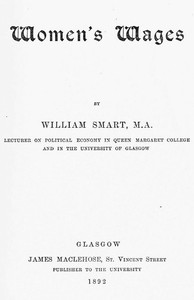
Women's wages — Story, Setting & Ideas
5
0
Project Gutenberg
2016
Wages -- Women; Sex discrimination against women; Equal pay for equal work
Readers of public-domain and historical texts
Project Gutenberg digital edition
en
Edition facts
Words: 11,147
Reading time: 49 min
Text sections: 2
Source:
Project Gutenberg record #52959
William Smart's 1891 lecture examines women's low wages through economic analysis, arguing that custom and subsistence levels, not skill, set pay. Drawing on Sidney Webb's data and the Lancashire weaving exception, Smart explores how trade unions and employer incentives shape wage disparities.
Editorial Edition Score
4.4/5
★★★★★
★★★★★
Calculated from edition completeness, EPUB availability, text structure and catalogue metadata. Not a user rating.
Edition quality
William Smart opens his 1891 lecture to the Philosophical Society of Glasgow with a blunt claim: it is 'not necessary to prove that women's wages are, as a rule, much under those of men.' He immediately anchors this assertion in a specific figure—ten shillings per week in Scottish textile trades—and contrasts it with a man's low average of twenty shillings. The tone is forensic, not polemical; Smart treats wage disparity as a given fact requiring explanation, not moral outrage. His method is to dissect the forces that fix women's pay, drawing on contemporary statistics and a telling exception: Lancashire weaving, where equal piece-work rates yield equal earnings.
The Customary Wage Hypothesis
Smart's central argument is that women's wages are often 'customary wages'—rates set in an earlier, poorer era when capital held more power. He supports this by noting that in many factories, wages are 'customary and almost fixed,' yet also low. The logic is circular: custom keeps wages low, and low wages reinforce custom. Smart strengthens his case by examining the apparent counterexample of Lancashire weaving. There, women earn equal wages to men—averaging 17s. 1d. to 21s. 4d.—but only because they belong to the same strong trade union. He warns that if the union broke down, employers would quickly reduce women's pay, men would leave the trade, and wages would fall to the general female level. This thought experiment reveals Smart's belief that custom, not skill or productivity, is the primary determinant.
Evidence from Government and Office Work
Smart draws on Sidney Webb's classification of women workers into four classes, dismissing artistic and intellectual workers as unaffected by sex-based wage gaps. He focuses on 'routine mental workers,' citing the Post Office, Telegraph Departments, and Savings Banks, where women do 'precisely similar work with men' yet earn less. The Prudential Life Assurance Office provides a striking example: since 1872, 243 women clerks have performed routine work 'more efficiently than men,' but their salaries start at £32 and cap at £60—roughly half what men would accept. In Glasgow, lady typists and shorthand writers offer services from 9:30 to 5 for £25. Smart also notes that teaching salaries in England and Wales average £119 for men and £75 for women, with similar gaps under the London School Board and in secondary schools.
The Subsistence Floor and Employer Incentives
Smart observes that women's wages cluster narrowly around a ten-shilling average, with 'small amounts of variation on one side or other.' This definiteness, he argues, suggests wages are near the 'level of subsistence'—the only definite level political economy has identified. He then examines employer behavior: manufacturers can increase profits by raising prices or reducing costs. In competitive markets, raising prices is difficult, so employers constantly seek cost reductions. In men's trades, unions jealously guard against wage cuts; in women's trades, where wages are customary, employers 'would not think of touching them'—but only because they are already low. Smart ventures that if cotton-spinning wages were 16s. instead of 10s., employers would attempt reductions. The implication is that women's wages are at a floor below which they cannot fall, not because of fairness, but because of biological necessity.
The Lancashire Exception and Its Fragility
Smart returns to Lancashire weaving as the 'great outstanding exception' to low women's wages. There, men and women work side by side under the same Factory Act restrictions, earning equal piece-work rates. The key factor is the strong trade union that includes both sexes; any attempt to reduce women's wages would be resisted by the entire union. But Smart warns this equilibrium is fragile. If the union collapsed, employers would quickly reduce women's pay, women would accept it to keep their jobs, men would leave for other industries, and power-loom weaving would become a female-only trade with wages at the general level. This scenario underscores Smart's broader thesis: without institutional protection, custom and employer pressure drive women's wages to subsistence. The exception proves the rule.
Smart's lecture is a tightly argued economic analysis, not a moral appeal. He relies on data from government reports, insurance offices, and trade statistics, and his reasoning is grounded in the logic of supply, demand, and custom. Readers should note that Smart does not advocate for specific reforms; instead, he diagnoses the structural forces that keep women's wages low. The lecture is valuable for its clear exposition of late-Victorian economic thought on gender and labor, and for its nuanced treatment of the Lancashire exception—a case that challenges but ultimately reinforces his central argument.
Reader reflection
Take a moment to reflect on this book
Create a short personal record of your experience with this book.
Your progress
0
/
10
2
How did the book work for you overall?
3
Is this a title you would suggest to others?
4
How easy was the book to follow?
5
Did the book deliver what you hoped for?
6
Did anything about the book feel genuinely new?
7
How understandable was the text?
8
Could you apply anything you learned?
9
What changed or sharpened your thinking?
10