1

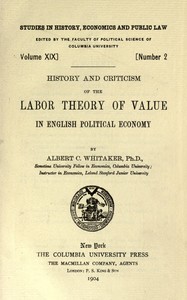
History and criticism of the labor theory of value in English political economy — Context and Discussion
30
6
Project Gutenberg
2025
Economics -- Great Britain -- History; Labor theory of value -- Great Britain -- History
Readers of public-domain and historical texts
Project Gutenberg digital edition
en
Edition facts
Words: 64,140
Reading time: 279 min
Text sections: 19
Source:
Project Gutenberg record #76432
This editorial note examines Albert C. Whitaker's 1904 study of the labor theory of value, focusing on his critical analysis of Cairnes's doctrine of non-competing groups and the role of reciprocal demand, based on excerpts from the text.
Albert C. Whitaker's 1904 study, originally a Columbia University dissertation, dissects the labor theory of value as it developed in English political economy. The excerpts reveal a methodical critic who tests each theorist's claims against logical consistency. Whitaker does not merely summarize; he identifies where arguments falter, such as when he notes that Cairnes's law of reciprocal demand "fails signally of fulfilling Cairnes's promise of a principle other than that of cost." The prose is precise, often dissecting a single sentence from a predecessor to expose its limitations.
Whitaker's Critical Method
Whitaker's approach is forensic. He takes a theorist's central claim—for instance, Cairnes's assertion that reciprocal demand provides a distinct principle of value—and tests it against the theorist's own framework. He writes that the law "merely requires the general level of international exchange values to be such that in the long run the exports of a nation just discharge its liabilities," reducing it to a truism rather than a mechanism for determining individual prices. This pattern recurs: Whitaker identifies a gap between a theory's promise and its actual explanatory power. He is especially attentive to how definitions shift. When Cairnes rejects entrepreneur's cost but builds his argument on wage and interest components, Whitaker points out the inconsistency. The reader gains a sense of a scholar who values clarity above deference.
The Doctrine of Non-Competing Groups
A central target is Cairnes's doctrine of non-competing groups. Whitaker traces its lineage to Senior, noting that it "merely adds emphasis to a point already made by Senior, namely, that the wages of skilled labor are out of proportion to the amount of labor cost remunerated." The doctrine challenges the labor theory by showing that wage differences between groups do not reflect differences in labor sacrifice. Whitaker quotes Cairnes's own concession that skill is not itself a cost but "an indication of that which is an element in cost—namely, the sacrifice... undergone in acquiring the skill." Yet Whitaker argues that under non-competing conditions, skilled wages exceed proportionate sacrifice, undermining the link between labor cost and value. He treats this as a serious, not merely theoretical, difficulty.
Reciprocal Demand and Its Limits
Whitaker scrutinizes Cairnes's application of reciprocal demand to inter-group exchange. He argues that the principle "is incapable of determining the value of any single good" and only sets a general balance of trade. The excerpts show him pressing Cairnes's logic: if reciprocal demand only ensures that exports and imports balance over time, it does not provide a "central point of gravitation" for individual exchange ratios. Whitaker's language is blunt: "The purport of the argument of Cairnes is no more than this." He treats the law as a necessary condition for equilibrium, not a theory of value. This critique echoes his broader concern: that economists often mistake a description of aggregate outcomes for a causal explanation of prices.
The Role of Subjective Cost
Throughout the excerpts, Whitaker returns to the concept of subjective cost—pain or abstinence. He notes that Cairnes, like Senior, treats interest as compensation for abstinence, making it "logically coördinate with wages." This move, Whitaker implies, multiplies the difficulties for a labor theory of value. If both wages and interest rest on subjective sacrifice, then value cannot be reduced to labor alone. Whitaker also observes that Cairnes's doctrine of non-competing groups shows that even if labor were the only cost, wage expenses would not reflect true labor sacrifice. The excerpts thus reveal a layered critique: the labor theory fails both because other costs exist and because labor costs themselves are misaligned with value under real market conditions.
Readers approaching Whitaker's work should expect a dense, argument-driven text that rewards careful attention to his logical moves. He does not offer a comprehensive history but a targeted critique of specific theoretical weaknesses. The excerpts suggest that his chief interest lies in the gap between theoretical claims and their operational definitions. Those familiar with Cairnes or Senior will find Whitaker's objections illuminating, while newcomers may need to consult the original theorists to fully gauge his points.
Reader reflection
Before you leave, reflect on the book
Use these questions to collect your thoughts before moving on.
Your progress
0
/
10
2
What was your overall reaction to the book?
3
Is this a title you would suggest to others?
4
What was the reading difficulty like?
5
How clear did the writing feel?
6
Would you like to discuss this book with someone?
7
How did the reading compare with what you expected?
8
How would you describe its reading pace?
9
What is the main idea you are taking away?
10