1

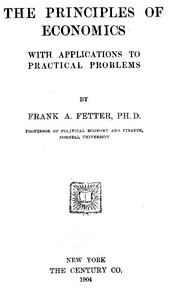
The Principles of Economics, with Applications to Practical Problems — Story, Setting & Ideas
5
0
Project Gutenberg
2012
Economics
Readers of public-domain and historical texts
Project Gutenberg digital edition
en
Edition facts
Words: 204,176
Reading time: 888 min
Text sections: 32
Source:
Project Gutenberg record #40077
This editorial note examines Frank A. Fetter's 1904 textbook through its language, narrative voice, and shifts in explanatory pace, focusing on how the author balances abstract theory with concrete examples and practical applications.
Editorial Edition Score
4.9/5
★★★★★
★★★★★
Calculated from edition completeness, EPUB availability, text structure and catalogue metadata. Not a user rating.
Edition quality
Frank A. Fetter's The Principles of Economics, with Applications to Practical Problems (1904) opens with a dedication to students at three universities, signaling its pedagogical intent. The text's language is formal yet direct, often addressing the reader as 'we' or 'one' to guide reasoning step by step. Fetter frequently uses analogies from everyday life—such as the baker selling bread or the sole druggist in a small town—to ground abstract concepts like monopoly pricing. This blend of theoretical exposition and concrete illustration creates a distinctive rhythm: dense passages of definition alternate with vivid, almost narrative examples that slow the pace for clarity.
The Voice of the Instructor
Fetter adopts the persona of a lecturer speaking to a classroom. He uses phrases like 'we have seen' and 'let us consider' to create a collaborative tone. The prose is precise but not dry; he occasionally employs rhetorical questions ('What is the nature of demand?') to anticipate the reader's confusion. This voice is consistent throughout the excerpts, though it becomes more urgent when discussing monopolistic practices, as in the passage on 'charging what the traffic will bear.' Here, the language sharpens: 'the burden is adjusted to the back, being made not as light but as heavy as each can be forced to bear.' The moral weight of such sentences contrasts with the neutral tone of earlier definitions.
Pacing: From Definition to Illustration
The text moves between two speeds. Slow, careful definitions of terms like 'diminishing returns' or 'capitalization' occupy whole paragraphs, with each concept broken into numbered subpoints. Then, abruptly, Fetter shifts to a faster, more narrative pace when applying theory to real-world scenarios. For instance, the discussion of monopoly price control suddenly introduces a hypothetical detective force to illustrate price discrimination. This change in tempo mirrors the book's subtitle: principles are laid out methodically, then tested against 'practical problems.' The effect is that abstract ideas feel immediately relevant, though the transitions can be jarring.
Recurring Structural Devices
Fetter relies on numbered lists and subheadings to organize arguments, a hallmark of early 20th-century textbooks. In the monopoly section, he uses '1.', '2.', and '3.' to separate types of control, then follows with a bolded subheading 'Low rates to destroy competitors.' This structure imposes clarity on complex material. Another recurring device is the hypothetical scenario: the baker who might 'deal with each customer separately' or the 'small competitor' ruined by predatory pricing. These mini-narratives serve as proof-of-concept for theoretical claims, grounding them in plausible human behavior. The cumulative effect is a text that feels both systematic and alive with practical reasoning.
Readers approaching Fetter's work should attend to how he uses language to teach: the shifts from abstract to concrete, the numbered lists that break down arguments, and the occasional moral inflection in his voice. The excerpts suggest a book that rewards careful reading of its definitions but also invites skimming of its illustrative stories. Pay attention to the moments when the pace slows—those are where Fetter is building the conceptual tools he expects you to apply later.
Reader reflection
How will you remember this book?
Save your reaction, strongest insight, and memorable passage.
Your progress
0
/
10
2
How much did you enjoy the reading experience?
3
How likely are you to recommend this book?
4
Did the language feel accessible?
5
Did any part of the book feel personally relevant?
6
Did anything about the book feel genuinely new?
7
Did you gain anything practical from the text?
8
How would you describe its reading pace?
9
What is the main idea you are taking away?
10