1

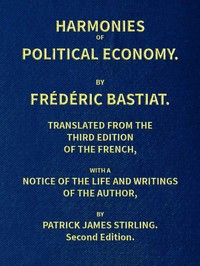
Harmonies of Political Economy Translated from the Third French Edition, with a Notice of the Life and Writings of the Author — Key Ideas to Explore
24
4
Project Gutenberg
2014
Economics
Readers of public-domain and historical texts
Project Gutenberg digital edition
en
Edition facts
Words: 235,713
Reading time: 1025 min
Text sections: 24
Source:
Project Gutenberg record #45002
Translator Patrick James Stirling's preface and Bastiat's posthumous chapters reveal a work shaped by its unfinished state, where economic arguments on value, capital, and property are delivered through vivid hypotheticals and rhetorical questions, demanding close attention to shifts in tone and completeness.
Editorial Edition Score
4.9/5
★★★★★
★★★★★
Calculated from edition completeness, EPUB availability, text structure and catalogue metadata. Not a user rating.
Edition quality
This edition of Harmonies of Political Economy is a layered document: a translation of Frédéric Bastiat's third French edition, completed after his death by friends from his manuscripts, and framed by translator Patrick James Stirling's preface. Stirling notes that only the first ten chapters had Bastiat's 'finishing touch'; the rest are fragments or chapters that 'indicate very clearly' his opinions but lack final polish. This editorial note examines how the work's unfinished character shapes its language, narrative voice, and changes in pace, drawing on the translator's preface and an excerpt from the chapter on capital and value.
The Translator's Framing of an Unfinished Work
Stirling's preface is itself a piece of editorial mediation. He describes how Bastiat, before his final journey to Italy, entrusted manuscripts to friends MM. de Fontenay and Paillottet, who arranged them 'without altering the text' and added only a few explanatory notes. This transparency about the text's provenance sets a careful tone: the reader is warned that some chapters are 'mere fragments,' while others display 'breadth, a vigour, and an originality' worthy of Bastiat's best days. Stirling also notes that Bastiat had intended to 'recast the work' to include applications to social philosophy, a plan cut short. This preface thus establishes a dual voice: the translator's scholarly caution and the author's interrupted ambition, creating a pace that shifts between confident exposition and tentative reconstruction.
Rhetorical Force and Hypothetical Extremes
In the excerpt on capital and value, Bastiat's argumentative style is unmistakable. He builds a chain of rhetorical questions—'Is it not true...?'—that drive the reader through a logical progression, then caps it with a vivid hypothetical: 'Having filled up the drain, demolish the fence... destroy the well, pull down the barn, dig up the road, burn the plough.' This cascade of destructive actions is meant to illustrate the absurdity of opposing property, and the pace accelerates from measured reasoning to a near-satirical crescendo. The language is concrete and muscular ('muscular force,' 'gratuitous law of hydrostatics'), grounding abstract economics in physical labor. The shift from analytical to polemical registers is abrupt, a hallmark of Bastiat's voice that the fragmentary chapters may amplify or disrupt.
Pace and the Unfinished Architecture
The posthumous chapters, as described by Stirling, introduce a structural unevenness. The first ten chapters, polished by Bastiat, likely maintain a steady expository pace. The later fragments, however, may vary wildly: some are 'mere fragments,' others more developed. This creates a reading experience where the argument's momentum is periodically broken, forcing the reader to infer connections. The excerpt's conclusion—'Will it indeed be given me to descri...'—breaks off mid-sentence, a literal interruption that mirrors the work's larger incompleteness. Such abrupt endings, combined with Stirling's notes, mean the reader must navigate between Bastiat's intended harmony and the editors' necessary interventions, a tension that defines the book's unique narrative rhythm.
Readers should approach this edition with attention to its layered authorship: Bastiat's original voice, the editors' arrangement, and Stirling's framing. The translator's preface and the posthumous chapters' fragmentary nature invite a comparative reading—one that notes where arguments feel finished and where they trail off. The rhetorical intensity of passages like the drain hypothetical rewards slow reading, while the structural gaps encourage speculation about Bastiat's larger design. This is not a seamless treatise but a workshop of ideas, preserved in mid-construction.
Reader reflection
What did you think of this book?
Answer a few questions and save a private reflection on this device.
Your progress
0
/
10
2
How much did you enjoy the reading experience?
3
Is this a title you would suggest to others?
4
How much effort did this book require?
5
How closely did the book connect with your experience?
6
Did the book offer a fresh perspective?
7
Which element worked best for you?
8
Did the book deliver what you hoped for?
9
What is the main idea you are taking away?
10