1

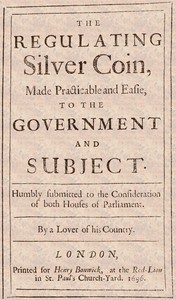
The Regulating Silver Coin, Made Practicable and Easie, to the Government and Subject — A Closer Reading
4
0
Project Gutenberg
2018
Coinage -- Great Britain -- Early works to 1800; Great Britain. Parliament -- Early works to 1800
Readers of public-domain and historical texts
Project Gutenberg digital edition
en
Edition facts
Words: 19,401
Reading time: 85 min
Text sections: 14
Source:
Project Gutenberg record #57020
Samuel Pratt's 1696 proposal for recoinage uses axioms and theorems to argue for compensating clipt money holders and encouraging plate importation, structuring economic argument as mathematical proof.
Samuel Pratt opens his 1696 pamphlet by acknowledging the difficulty of writing on a subject already treated by a 'late learned and industrious Writer' (likely William Lowndes). He distinguishes his approach: 'I am contented to be understood without shining, and to offer Mathematical Reasoning, without polishing and Ornament.' This self-conscious positioning frames the work as a technical supplement rather than a rival. Pratt's text is structured around axioms and a theorem, mirroring geometric demonstration. He repeatedly contrasts his 'Design' with others' proposals, particularly the compulsory melting of plate, which he deems 'an attempt I doubt of pernicious Consequence.'
Axioms as Argumentative Scaffolding
Pratt builds his case on five numbered axioms, each asserting a condition for stable coinage. For instance, Axiom II states that coin cannot be secured against exportation, melting, or hoarding 'unless it have either a real, or extrinsick value above the intrinsick.' Axiom V insists that any added value must be 'settled by an unquestionable Security applicable to every particular persons Use.' These axioms are not merely rhetorical; they function as premises from which his ten-article proposition logically follows. The structure mimics a mathematical treatise, lending an air of inevitability to his conclusions. Pratt even labels his central proposal a 'Theorem,' reinforcing the impression that his plan is demonstrable rather than merely advisable.
Movement Between Two Audiences
Pratt repeatedly addresses two imagined opponents: 'Those that know little of the Subject-Matter, and those that know much.' The former are 'Jealous,' the latter 'Opiniatre.' This rhetorical move allows him to preempt criticism from both ignorance and expertise. He also shifts between addressing Parliament directly and speaking as a 'private man' who 'cannot dictate.' In one passage, he writes, 'if the wisdom of Parliament thinks fit to make Compensation for all the Counterfeit Money, I have nothing to say against it: They are the proper Judges.' This deferential posture contrasts with the assertive, axiomatic core of the work, creating a dynamic tension between humility and certainty.
Recurring Images of Weight and Measure
Throughout the excerpts, Pratt returns to physical metaphors of weight and measure. He describes how the debasement of coin happened 'by gradual and sensible approaches,' making it 'Curious, so Subtil, and small as was not to be easily suspected.' The clipt money, when melted, 'produced but one' million pounds from two. He proposes paying back '75 l. per Cent. back in Specie' and calculates the total public expense at 'Two hundred and fifty thousand Pounds.' These concrete figures anchor his abstract reasoning. Even the phrase 'Caveat Emptor' applied to counterfeit money suggests a marketplace where weight and trust are intertwined. Pratt's language consistently ties monetary value to physical substance.
The Proposition as a Ten-Point Plan
Pratt's central proposition is a numbered list of ten articles, ranging from calling in clipt money to setting a land tax of 'a Penny in the Pound during the War.' The list moves from immediate action (speedy calling in of old money) to long-term goals (increasing silver coinage to five million pounds). Each article is stated as a directive: 'That the Exportation of Silver Money beyond the Permission of the King and Parliament, be effectually hinder’d.' The final article promises all ten can be accomplished at no more than 'Two hundred and fifty thousand Pounds at present.' This plan is the practical culmination of the preceding axioms, and its clarity contrasts with the earlier defensive tone.
Pratt's pamphlet is best approached as a specimen of early economic reasoning that borrows the form of mathematical proof. Readers should attend to how he balances deference to authority with the boldness of his own scheme. The recurring tension between 'Mathematical Reasoning' and political persuasion gives the work its character. The ten articles offer a concrete entry point, while the axioms reveal the underlying logic. Pratt's voice—alternately cautious and confident—shapes an argument that is as much about credibility as about coinage.
Reader reflection
Record your reading impressions
A brief reflection can help important ideas stay with you longer.
Your progress
0
/
10
2
How did the book work for you overall?
3
Would you encourage someone else to read it?
4
How much effort did this book require?
5
Would you read this book again?
6
Did the book deliver what you hoped for?
7
How strongly did the book affect you emotionally?
8
Was the book moving at the right speed?
9
What changed or sharpened your thinking?
10