1

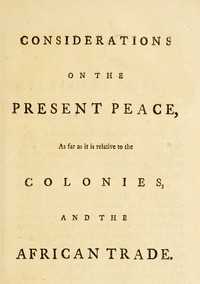
Considerations on the present peace, as far as it is relative to the colonies, and the African trade — Background and Themes
15
2
Project Gutenberg
2022
Slave trade -- Africa -- Early works to 1800; Great Britain -- Colonies -- Commerce -- Early works to 1800
Readers of public-domain and historical texts
Project Gutenberg digital edition
en
Edition facts
Words: 25,437
Reading time: 111 min
Text sections: 7
Source:
Project Gutenberg record #69348
An anonymous 1763 pamphlet arguing that the 1750 reorganization of the African trade harmed British planters by raising slave prices, supported by letters from ship captains and a critique of the fort system.
Editorial Edition Score
4.6/5
★★★★★
★★★★★
Calculated from edition completeness, EPUB availability, text structure and catalogue metadata. Not a user rating.
Edition quality
The pamphlet opens by addressing itself directly to “the British planters,” disclaiming any authorial ambition and presenting its contents as unadorned facts. Its central claim is that the African trade, as restructured in 1750, has proved “extreamly detrimental to the British colonies” by inflating the price of enslaved people. The editors distinguish between “real planters” and those who are also merchants, suggesting that the latter have a financial interest in keeping prices high. This framing sets up a polemic grounded in economic self-interest rather than moral argument.
Evidence from the Coast: Letters and Testimonials
The pamphlet reproduces several letters from ship captains stationed at Annamaboa Road in 1750–1751. These documents serve as primary evidence for the editors’ claims. For instance, Alexander Graham of the Fly sloop thanks the governor of Cape Coast Castle for assistance in sending off French vessels and mentions altering “handcuffs.” Another letter, from six British masters, complains that French traders have “too much invaded” British privileges. A third, from Richard Haskins, requests a carpenter. These excerpts are not merely illustrative; they are presented as proof of the governor’s cooperation and the practical challenges of the trade.
The letters also reveal tensions among European traders. Henry Ellis of the Hallifax notes that “new agents” are “settling factories ashore to intercept the trade” and giving “equal prices,” forcing British captains to raise their offers. He observes the “chagrin of the Liverpool captains” and calls the new arrangement “an errand job.” A certificate signed by eight masters defends the governor against accusations of tyranny, attesting to his “humane and good” conduct. These documents collectively argue that the 1750 reforms disrupted established commercial practices and harmed British interests.
The Forts and the Cost of Enslaved People
The editors assert that the forts on the African coast are “by no means upon a proper establishment.” They contend that the current system forces European merchants to pay “very high price[s] for Negroes,” with profits split between European and African traders. This, they argue, becomes “extreamly burthensome and disadvantageous” to planters. The pamphlet does not provide a detailed alternative plan but implies that the forts should be managed to reduce costs. The letters support this by showing that captains had to raise prices to compete with French and Liverpool rivals, directly affecting the bottom line for colonial buyers.
One striking detail comes from Henry Ellis, who writes about the death of enslaved people: “we cannot help the death of the slaves, they are mortal.” He advises against feeding them rice, as that diet “first gave them a swelling.” A note adds that he landed his “sickly slaves” at the castle for care. These passages reveal the brutal calculus of the trade, where human life is weighed against profit, and the pamphlet’s economic argument is grounded in such realities.
Structure and Rhetorical Strategy
The pamphlet is organized as a series of factual presentations rather than a continuous argument. It opens with an address to planters, then moves to extracts and certificates, each introduced with a brief heading. The editors claim no authorship—“Author is a title they lay no claim to”—and rely on the “unornamented energy” of the documents to persuade. This rhetorical posture of plainness is itself a strategy, designed to contrast with the “false pretenders to knowledge” they criticize.
The use of dated letters and certificates gives the work an evidentiary, almost legal character. The editors do not explicitly state their own conclusions in the excerpts provided; instead, they let the documents speak. This approach suggests that the pamphlet was intended for an audience familiar with the trade and capable of drawing inferences. The final sections (not fully excerpted) likely elaborate on the policy implications, but the surviving text emphasizes the gap between official reforms and on-the-ground realities.
Readers should approach this pamphlet as a piece of advocacy rooted in specific commercial grievances. Its value lies less in its policy proposals than in the raw testimony it preserves—letters that capture the language, logistics, and moral indifference of the slave trade in the 1750s. The editors’ insistence on factual presentation invites scrutiny of their sources and omissions. Comparing the letters’ claims with other contemporary accounts would deepen understanding of the trade’s complexities.
Reader reflection
Record your reading impressions
A brief reflection can help important ideas stay with you longer.
Your progress
0
/
10
2
Was reading this book enjoyable?
3
Would you recommend this book to another reader?
4
Did the language feel accessible?
5
What did you appreciate most?
6
Would you like to discuss this book with someone?
7
Did any part of the book stay with you emotionally?
8
How would you rate its originality?
9
What changed or sharpened your thinking?
10