1

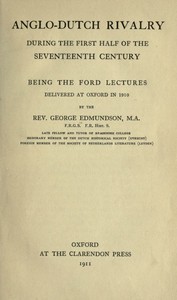
Anglo-Dutch Rivalry During the First Half of the Seventeenth Century being the Ford lectures delivered at Oxford in 1910 — Edition Insights
19
3
Project Gutenberg
2015
Great Britain -- Foreign relations -- Netherlands; Netherlands -- Foreign relations -- Great Britain; Great Britain -- Commerce -- History -- 17th century; Netherlands -- Commerce -- History -- 17th century
Readers of public-domain and historical texts
Project Gutenberg digital edition
en
Edition facts
Words: 53,617
Reading time: 234 min
Text sections: 5
Source:
Project Gutenberg record #48697
George Edmundson's 1910 Ford Lectures trace the commercial and maritime tensions between England and the Dutch Republic from 1600 to 1652, using diplomatic records and contemporary commentary to show how disputes over fisheries, contraband, and colonial incidents like the Amboina massacre fueled an inevitable conflict.
Editorial Edition Score
4.7/5
★★★★★
★★★★★
Calculated from edition completeness, EPUB availability, text structure and catalogue metadata. Not a user rating.
Edition quality
George Edmundson opens his Ford Lectures by noting that the Anglo-Dutch wars of 1652–1674 are often remembered through legends—Tromp's broom at the masthead, de Ruyter's raid on Chatham—while the underlying causes remain less familiar. He sets out to examine the half-century before the first clash, arguing that the wars were the 'inevitable outcome' of a long clash of vital interests. The lectures, delivered at Oxford in 1910, draw on Dutch and English sources to reconstruct a period when political and religious questions have, in Edmundson's view, overshadowed the commercial rivalry that shaped national destinies.
The Amboina Massacre as a Recurring Grievance
Edmundson repeatedly returns to the 1623 Amboina massacre as a point of contention that the Dutch sought to defer and the English refused to drop. In the negotiations of 1627, the Dutch envoy Jacob Cats found himself confronted with English demands for indemnities over Amboina, alongside disputes about herring fisheries off Scotland and whaling at Spitzbergen. Cats pleaded that these matters were not in his instructions, and he succeeded in postponing them—a tactic Edmundson calls 'the policy of delay, which had proved so successful in the past.' The indemnities 'continued to be claimed, but remained unpaid.' This pattern of grievance and evasion, the lectures suggest, poisoned relations long before open war.
Contraband and the Right of Search
A central tension in Edmundson's account is the Dutch insistence on freedom to trade even with Spain, England's enemy, during the Dutch Revolt. The Treaty of Southampton had forbidden such traffic, but Amsterdam merchants evaded the restriction. English reprisals followed, and bitter complaints arose on both sides. Cats's 1627 mission aimed to negotiate a Navigation Treaty covering contraband and the right of search, but no agreement was reached. Edmundson quotes the contemporary historian Aitzema, who observed that each side accused the other of offences in which they themselves were more guilty: 'The big fishes eat the small ones. He who has the might uses it.' The deadlock over these maritime rules, the lectures imply, made conflict almost unavoidable.
The Role of the Fisheries and the Spitzbergen Disputes
Edmundson highlights the herring fisheries off Scotland and the whaling grounds at Spitzbergen as flashpoints where English and Dutch interests collided directly. The Dutch herring fleet operated under protest but 'undisturbed,' while the English government complained of violence. These disputes were bundled into the same diplomatic package as Amboina, and like that grievance, they were repeatedly postponed rather than resolved. The lectures show how economic pressure—the Dutch reliance on free access to these waters—clashed with English claims of sovereignty and control. Edmundson's treatment of these episodes illustrates his broader argument that commercial rivalry, not ideology, drove the two nations toward war.
Edmundson's lectures offer a detailed, source-based account of a rivalry that is often reduced to naval battles. Readers will find the most value in the diplomatic exchanges and the author's use of contemporary commentators like Aitzema, who capture the cynicism and self-interest of both sides. The incomplete excerpts leave the later escalation toward 1652 unexplored, but the pattern of postponed disputes and mutual suspicion is already clear.
Reader reflection
Record your reading impressions
A brief reflection can help important ideas stay with you longer.
Your progress
0
/
10
2
Did this book hold your interest?
3
Would you encourage someone else to read it?
4
Did the language feel accessible?
5
How clearly were the main ideas presented?
6
How much did the book move you?
7
How would you rate its originality?
8
Would you like to discuss this book with someone?
9
Which lesson or insight stayed with you?
10