1

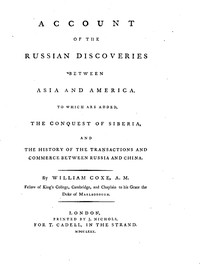
Account of the Russian Discoveries between Asia and America To which are added, the conquest of Siberia, and the history of the transactions and commerce between Russia — A Closer Reading
14
2
Project Gutenberg
2015
Discoveries in geography -- Russian; Islands of the Pacific; Siberia (Russia) -- History; Russia -- Commerce -- China; China -- Commerce -- Russia
Readers of public-domain and historical texts
Project Gutenberg digital edition
en
Edition facts
Words: 85,075
Reading time: 370 min
Text sections: 14
Source:
Project Gutenberg record #49637
William Coxe's 1780 compilation of Russian voyages between Asia and America, based on journals and Muller's authentication, with added histories of Siberia's conquest and Russo-Chinese commerce. The excerpts show a diplomatic and military focus, not just geography.
Editorial Edition Score
4.9/5
★★★★★
★★★★★
Calculated from edition completeness, EPUB availability, text structure and catalogue metadata. Not a user rating.
Edition quality
William Coxe opens his preface by crediting Dr. Robertson's History of America for sparking public interest in Russian discoveries, then explains that during his stay in Petersburg he sought newer information. He obtained a German treatise (1776) whose anonymous author, Coxe was assured, used original journals. To verify, Coxe consulted the archivist Mr. Muller, who had arranged those same journals and gave a strong written endorsement: the author was supplied with good memoirs and used them faithfully. This chain of authentication—Robertson, the anonymous compiler, Muller—frames the work as a secondhand but verified synthesis, not a firsthand narrative.
Authenticating the Sources
Coxe does not present himself as an explorer. He is a compiler who collected journals of voyages after Bering and Chirikov (1741), the point where Muller's account ended. The key source is an anonymous German book from 1776. Coxe sought Muller's opinion, and Muller compared it to the original papers. The result is a rare instance where a secondary work receives explicit archival vetting. The excerpts show Coxe quoting Muller's French letter: "Il n'y a point de doute, que l'auteur n'ait eté pourvu de bons memoires, et qu'il ne s'en foit fervi fidelement". This reliance on a single anonymous text, despite Muller's endorsement, means the reader depends on Coxe's judgment of that source's fidelity.
Military and Diplomatic Emphasis
The catalog subjects list Discoveries in geography and Islands of the Pacific, but the excerpts from the history of Russo-Chinese relations focus on sieges, treaties, and troop movements. Chapter II describes the siege of Albasin, where Chinese forces with "a large train of artillery" battered the fortress for weeks. The Russian garrison, though making "a gallant resistance," was exhausted by sickness and famine. The negotiation at Nershinsk is depicted as coerced: the Chinese ambassadors arrived with "such a numerous army" that Golovin was "constrained, from motives of fear, to conclude the negotiation almost upon their own terms." This is a narrative of power imbalance, not discovery.
Geographic and Political Scope
The work's full title promises coverage from Asian-American discoveries to the conquest of Siberia and Russo-Chinese commerce. The excerpts show that the Siberian conquest is treated as a prelude to conflict with China: "all the various tribes of independent Tartary... would have followed the fate of the Siberian hordes, if the power of China had not suddenly interposed." The catalog subject Siberia (Russia) -- History is thus interwoven with Chinese expansion under Emperor Camhi (Kangxi). The Pacific islands, though listed, are not visible in these excerpts; the text's center of gravity lies in continental borderlands and trade routes.
Readers should approach this book as a document of eighteenth-century information gathering. Coxe's method—collecting, authenticating, and translating—mirrors the imperial networks he describes. The excerpts reveal a work more concerned with treaties and fortresses than with ethnographic or geographic detail. For the Pacific voyages, one must look beyond these samples; the Russo-Chinese sections, however, offer a concentrated view of how European scholars pieced together Asian geopolitics from fragmentary sources.
Reader reflection
What was your reading experience?
Capture what you thought, learned, and would like to remember.
Your progress
0
/
10
2
How did the book work for you overall?
3
Would you encourage someone else to read it?
4
What was the reading difficulty like?
5
Could you see yourself revisiting this book?
6
How well did it match your expectations?
7
Could you follow the author’s main argument?
8
Did you gain anything practical from the text?
9
What is the main idea you are taking away?
10