1

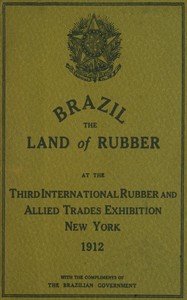
Brazil, the land of rubber — Reading Notes
26
4
Project Gutenberg
2025
Rubber industry and trade -- Brazil; Rubber -- Exhibitions
Readers of public-domain and historical texts
Project Gutenberg digital edition
en
Edition facts
Words: 59,286
Reading time: 258 min
Text sections: 31
Source:
Project Gutenberg record #75473
This 1912 exhibition catalog combines a detailed description of Brazil's rubber court at the New York trade show with official decrees on railroad concessions and river navigation, revealing how promotional spectacle and regulatory policy jointly framed the Amazonian rubber industry.
Editorial Edition Score
4.9/5
★★★★★
★★★★★
Calculated from edition completeness, EPUB availability, text structure and catalogue metadata. Not a user rating.
Edition quality
The volume opens not with an argument but with a guided tour of the Brazilian Court at the Third International Rubber and Allied Trades Exhibition in New York, 1912. The description is precise: a ten-thousand-square-foot balcony floor, an archway bearing federal arms, a refreshment kiosk dispensing Brazilian coffee, and a 1,600-pound rubber ball. The prose moves from the Rubber Colossus statue to life-sized models of workers, then to Dr. Pinto demonstrating a smokeless coagulation process. This is not a detached report; it is a piece of national promotion, written to impress manufacturers and visitors alike.
Promotional Display as Primary Evidence
The exhibition description is the most complete narrative in the excerpts. It treats the court as a miniature Brazil: maps, statistics, photographs, and moving pictures are arranged to tell a story of abundance and modernity. The text notes that the walls are hung with statistics and maps, and that a series of pictures offers a bird’s eye view tour up the Amazon. The inclusion of a working demonstration—Dr. Pinto coagulating latex—signals that the exhibit aimed to prove technical progress. Yet the catalog does not explain how representative these displays were of actual conditions in the rubber fields. The reader sees only what the Brazilian Government chose to show.
Legal Framework as a Second Layer
Later sections shift abruptly to legislative text: articles from a decree on economical railroads and river navigation improvements. The language is bureaucratic, specifying gauge widths, revenue thresholds, and concession terms up to ninety years. Article 53 ties railroad concessions to colonization and land development, not just transport. Article 58 lists specific river sections to be improved for steamers drawing three feet. These provisions reveal a state attempting to engineer infrastructure for rubber extraction. The contrast between the polished exhibition narrative and the dry legal code is stark—one sells an image, the other sets the rules.
What the Excerpts Do Not Show
Despite the catalog’s title, the excerpts contain almost no description of rubber trees, tapping methods, or the daily work of seringueiros. The exhibition includes life-sized models of workers, but the text does not describe their labor. The legal articles mention colonization and marginal lands but give no voice to the people who would live there. The catalog is a document of official Brazil—its ambitions, its self-presentation, its regulatory machinery. The actual rubber industry, as experienced by workers and local communities, remains largely invisible. This gap is itself informative: the book is a record of how the state and commercial interests wanted the industry to be seen.
Readers should approach this text as a hybrid: part trade-show brochure, part government publication. The exhibition tour and the legal decrees are not separate genres but complementary efforts to control the narrative of Brazilian rubber. Pay attention to what is displayed and what is omitted—the workers, the ecology, the economics of extraction. The catalog is a primary source for understanding early twentieth-century promotional culture and state-led development, not a comprehensive study of the rubber trade itself.
Reader reflection
Take a moment to reflect on this book
Create a short personal record of your experience with this book.
Your progress
0
/
10
2
How much did you enjoy the reading experience?
3
Would you recommend this book to another reader?
4
How easy was the book to follow?
5
Did the book give you something worth debating?
6
How much did the book move you?
7
Was the book moving at the right speed?
8
How clearly were the main ideas presented?
9
What did this book teach you most?
10