1

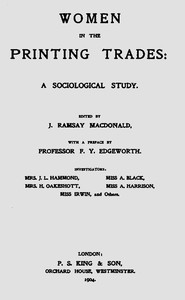
Women in the Printing Trades: A Sociological Study. — Key Ideas to Explore
13
1
Project Gutenberg
2013
Women -- Employment -- Great Britain; Working class women -- Great Britain; Women printers -- Great Britain; Printing industry -- Great Britain
Readers of public-domain and historical texts
Project Gutenberg digital edition
en
Edition facts
Words: 77,435
Reading time: 337 min
Text sections: 17
Source:
Project Gutenberg record #42275
A 1904 sociological study edited by J. Ramsay MacDonald, examining women's labor in British printing trades through detailed wage data, home vs. factory work, and the social pressures shaping married women's employment.
Editorial Edition Score
4.8/5
★★★★★
★★★★★
Calculated from edition completeness, EPUB availability, text structure and catalogue metadata. Not a user rating.
Edition quality
The study opens with a pointed editorial reminder that 'the same work nominally is not always the same work actually,' a caution that sets the tone for its methodical approach to wage disparities. Investigators contrast men who 'carry formes' with women performing lighter tasks, revealing how job titles mask real differences in physical demands and pay. This attention to granular detail—down to 'farthings in the additions' of wage columns—characterizes the volume's commitment to evidence over assumption.
Voice and Structure of the Investigation
The editorial voice is collective and institutional, reflecting the work of multiple investigators—Mrs. J. L. Hammond, Miss A. Black, and others—under MacDonald's editorship. The preface by Professor F. Y. Edgeworth frames the study as a 'solid contribution' to political economy, but the body text often shifts to raw investigator reports. For instance, one passage quotes a worker's blunt explanation: 'a girl who has been accustomed to make 18 s. for herself is not comfortable when she marries a man on £2 a week.' These embedded voices break the academic tone, giving the reader direct access to the women's reasoning. The structure alternates between statistical appendices and narrative testimony, creating a rhythm of hard data and lived experience.
Pace Shifts: From Factory Floors to Home Workshops
The narrative pace changes markedly when moving from organized factory settings to the chaotic world of home-based paper-bag making. In factories, the text proceeds methodically through wage tables and age distributions. But when describing home workers, the prose quickens with specific, almost ethnographic detail: 'Mrs. —— is one of nine daughters, and seven are paper-bag makers.' The investigators report homes as 'very squalid and evil-smelling slum[s],' and note that women work only until they earn a specific sum—'say 10 s.'—then stop. This contrast in pace underscores the disorganization of home labor versus the regulated factory environment, and the text lingers on the precariousness of such piecework.
Recurring Motif: The Married Woman's Return
A persistent theme is the social stigma against married women working. The investigators note that 'the custom in the trades under review undoubtedly is that married women should not work in them,' and that only 'widowhood, or a bad or sickly husband' brings them back. One worker's comment—'They come back after they have married'—is echoed across reports. The text also records a telling remark about a manager who 'never will take married women, but then he is always such a gentleman,' revealing how chivalry and economic control intertwine. This motif recurs with statistical backup: the average age of women workers is low, 'mainly between eighteen and twenty-three,' because most leave at marriage. The study thus traces how marital status shapes labor patterns and wage levels.
Readers should attend to the interplay between the editors' cautious conclusions and the raw investigator reports. The study is richest when the women's own words break through the sociological framework, offering unfiltered perspectives on wages, home life, and the 'lingering shadow of chivalry.' The appendices, though dense with figures, reward close reading for the subtle discrepancies they reveal between nominal and actual work.
Reader reflection
How did this book work for you?
Your answers remain private and are stored only in this browser.
Your progress
0
/
10
2
How did the book work for you overall?
3
Would you recommend this book to another reader?
4
How easy was the book to follow?
5
How useful did the reading feel?
6
How did the reading compare with what you expected?
7
How strong was your personal connection to the text?
8
Did any part of the book stay with you emotionally?
9
What changed or sharpened your thinking?
10