1

The Theory of Stock Exchange Speculation — Themes and Context
4
1
Project Gutenberg
2019
Speculation
Readers of public-domain and historical texts
Project Gutenberg digital edition
en
Edition facts
Words: 44,307
Reading time: 193 min
Text sections: 6
Source:
Project Gutenberg record #59518
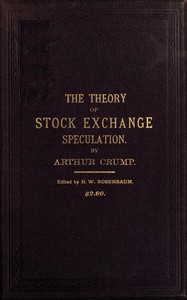
Arthur Crump's 1887 treatise on stock speculation, edited by broker H.W. Rosenbaum, contrasts disciplined method with market gambling. Rosenbaum's preface disputes Crump's pessimism, citing successful speculators. The text warns against over-reliance on telegraphic speed and urges systematic planning.
Arthur Crump's The Theory of Stock Exchange Speculation arrives in this 1887 American edition with a notable framing device: editor H.W. Rosenbaum, a New York broker, writes a preface that openly disagrees with parts of the author's argument. Rosenbaum concedes that Crump's strength lies in identifying the character traits needed for success—"a clear head; second, capital; and third, patience"—but he pushes back against the notion that profit is nearly impossible. This tension between the author's caution and the editor's practical experience sets the stage for a work that is as much about the psychology of the speculator as about market mechanics.
A Broker's Dissent in the Preface
Rosenbaum's preface does more than introduce the text; it actively contests Crump's central claim that speculation offers little chance of profit. Drawing on his own Wall Street experience, Rosenbaum asserts that "many speculators accumulate large fortunes" when they treat speculation "as a matter of business and not as a matter of amusement." He directly refutes Crump's implication that a successful speculator must be "hard-hearted" and selfish, pointing to prominent figures like Gould and Vanderbilt as examples of men who, though not typical speculators, operated with integrity. This editorial intervention colors the entire book, reminding readers that the advice within is filtered through a practitioner's lens.
The Peril of the Telegraph and the Need for System
Crump devotes a chapter to "Modern Influences upon the Markets," focusing on how the telegraph has transformed speculation. He argues that the electric wire "cuts both ways"—it enables rapid fortune-making but also swift ruin. The old model of a financier sailing to London to buy Consols after Waterloo is obsolete; now, a speculator must have "all the elaborate machinery" of a systematic plan. Crump insists that without a fixed line of action and the discipline to adhere to it, the speculator "must inevitably in the long run lose his money." The telegraph, he warns, creates an illusion of control that can amplify losses when second thoughts override first judgments.
The Volcano of Speculative Brokerage
Crump offers a structural critique of the brokerage industry, arguing that the majority of brokers depend on speculative "time bargains" rather than legitimate investment business. He estimates that only one-tenth to one-twentieth of brokers would be needed if markets were confined to bona fide transactions. This creates a system where brokers are compelled to encourage gambling to survive, living "on the crust of a volcano." The passage is striking for its moral clarity: Crump sees speculation not merely as risky but as a systemic evil that distorts the entire market ecosystem. The metaphor of the volcano recurs, underscoring the precariousness of a profession built on unstable ground.
Readers should note that the excerpts provided are incomplete; the full text likely develops Crump's systematic approach further. The editorial note is based solely on the preface and the first two chapters visible here. Pay attention to how Crump's warnings about character and method resonate—or clash—with Rosenbaum's more optimistic broker's perspective. The book rewards those who read it as a dialogue between theory and practice, rather than a single authoritative voice.
Reader reflection
What was your reading experience?
Capture what you thought, learned, and would like to remember.
Your progress
0
/
10
2
Was reading this book enjoyable?
3
Would you recommend this book to another reader?
4
How easy was the book to follow?
5
How valuable was this book for your own interests?
6
How closely did the book connect with your experience?
7
Which aspect of the book did you value most?
8
What was its emotional impact?
9
What did this book teach you most?
10