1

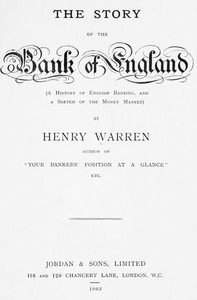
The Story of the Bank of England (A History of English Banking, and a Sketch of the Money Market) — A Reader’s Guide
5
1
Project Gutenberg
2020
Bank of England -- History; Banks and banking -- England
Readers of public-domain and historical texts
Project Gutenberg digital edition
en
Edition facts
Words: 52,972
Reading time: 231 min
Text sections: 19
Source:
Project Gutenberg record #63449
Henry Warren traces the Bank of England's evolution from its 1694 founding through the early 1900s, focusing on structural changes, the 1844 Act, and the interplay between the Bank, joint-stock banks, and the money market. The narrative moves between institutional history and broader economic shifts, using recurring images of expansion and concentration.
Editorial Edition Score
4.7/5
★★★★★
★★★★★
Calculated from edition completeness, EPUB availability, text structure and catalogue metadata. Not a user rating.
Edition quality
Henry Warren opens his history of the Bank of England not with the Bank itself but with its founder, William Paterson, a Scotsman whose earlier Darien scheme had ended in disaster. This framing sets a pattern: Warren repeatedly measures institutional success against personal or national failure. The Bank, he notes, was originally a finance company in every sense, and its early monopoly period (1708–1826) is presented as a time of cautious consolidation. Warren's prose moves between the boardroom and the broader economy, tracing how the Bank's structure—governor, sub-governor, twenty-four directors—shaped its responses to crises.
From Monopoly to Competition
Warren devotes the opening chapter to the Bank's monopoly period, emphasizing how the Bank's privileged position insulated it from competition until 1826. He notes that the Bank's directors were content to look on as new joint-stock banks expanded, confident that such sudden change must end in disaster. This confidence proved misplaced: the newcomers succeeded because their system was adaptable to a growing England. Warren's language here is pointed: the orthodox seldom play the role of prophet successfully, having lived too long in one groove. The image of the private banker confined to a single street recurs as a symbol of obsolescence.
The 1844 Act and Its Aftermath
The second chapter examines the Bank Charter Act of 1844, which separated the Bank into Issue and Banking departments. Warren treats this as a pivotal structural reform, but he does not present it as a clean solution. Instead, he shows how the Act's rigid rules were tested by subsequent panics. The weekly return of the Bank becomes a recurring motif—a document that reveals the tension between the gold reserve in the Issue Department and the liabilities of the Banking Department. Warren's analysis of these returns is precise: he notes the store in the Issue Department and the weekly differences that signal strain.
Banks and the Creation of Credit
Warren moves beyond the Bank of England to consider the broader banking system. He argues that banks do not merely lend existing money but create credit, and that this power is central to economic expansion. The chapter titled 'Banks and the Creation of Credit' is one of the most conceptually ambitious, linking institutional mechanics to market dynamics. Warren uses the image of tentacles spreading north, south, east, and west to describe how joint-stock banks extended their reach, confining private bankers to their ancestral streets. This organic metaphor—expansion as a living, grasping force—recurs throughout the book.
Panic Years and the Money Market
The final sections of the book turn to crisis management. Warren devotes a chapter to panic years, though the excerpts do not reveal which specific panics he covers. He also discusses the Bank rate and its effect on stock exchange securities, and the role of the short loan fund. The tone becomes more urgent as he describes how the Bank, as lender of last resort, must balance its own solvency against the stability of the market. Warren's recurring phrase 'the adaptability of their system to a changing market' serves as a refrain, suggesting that survival depends not on tradition but on flexibility.
Warren's history is less a chronicle of events than an argument about institutional adaptation. Readers should attend to his recurring structural contrasts—monopoly versus competition, London versus the provinces, the Bank versus joint-stock banks—and to the way he uses the weekly return as a diagnostic tool. The book rewards those who follow the movement between specific mechanisms (the Issue Department's gold store) and broad forces (the changing market). Warren's own voice, skeptical of orthodoxy and alert to irony, gives the narrative a distinctive edge.
Reader reflection
Before you leave, reflect on the book
Use these questions to collect your thoughts before moving on.
Your progress
0
/
10
2
How much did you enjoy the reading experience?
3
How likely are you to recommend this book?
4
How demanding did the text feel?
5
Did the book offer a fresh perspective?
6
Was the book moving at the right speed?
7
Do you expect to return to this book?
8
Could you apply anything you learned?
9
What is the main idea you are taking away?
10