1

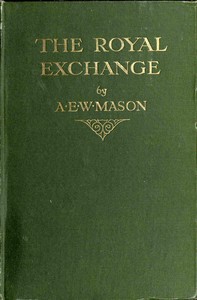
The Royal Exchange — Edition Insights
23
4
Project Gutenberg
2025
Royal Exchange Assurance (Firm) -- History; Royal Exchange (London, England) -- History
Readers of public-domain and historical texts
Project Gutenberg digital edition
en
Edition facts
Words: 20,061
Reading time: 88 min
Text sections: 10
Source:
Project Gutenberg record #75944
A.E.W. Mason's bicentenary note on the Royal Exchange Assurance traces the building's three incarnations from Gresham's 1571 Burse to the 1838 fire, and the corporation's 1720 charter amid the South Sea Bubble, with wry asides on the hazards of insurance history.
Editorial Edition Score
4.8/5
★★★★★
★★★★★
Calculated from edition completeness, EPUB availability, text structure and catalogue metadata. Not a user rating.
Edition quality
Mason opens with Queen Elizabeth dining at Sir Thomas Gresham's mansion in 1571, noting that the social barriers between City and Court had not yet risen—'Wars and the art of soldiering have been from time immemorial the great origins of social divisions, and these were times of peace.' The Queen's visit to open Gresham's new Burse sets the tone for a narrative that moves between architectural history and corporate origins. Mason's voice is dry and anecdotal, admitting that no record survives of what Elizabeth whispered to Gresham, but he speculates she hinted at the epithet 'Royal.' The book is structured in two parts: 'The House' (three chapters on the successive buildings) and 'The Business' (four chapters on the assurance corporation).
A Bourse Becomes Royal
Mason devotes the first chapter to Sir Thomas Gresham, a member of the Mercers' Company and Royal Agent in the Low Countries. He emphasizes that in 1571 there was 'no West End'—great nobles lived alongside merchants, and the latter held social esteem. The first Royal Exchange was built as a Burse, modeled on the Antwerp exchange. Mason notes that the Queen's visit was 'no such great mark of distinction as in these days it would be,' because Gresham was already a person of importance. The chapter ends with the building's destruction in the Great Fire of 1666, leading to the second Exchange. Mason's method is to weave personal details—Gresham's mansion, the French ambassador's account—into the institutional story.
Charters, Bubbles, and a Civil List Shortfall
The second part pivots to 1720, when two insurance companies—the London Assurance and the Royal Exchange Assurance—proposed to make good a £600,000 deficiency in King George's Civil List in return for their charters. Mason notes that the Royal Exchange Assurance took its name from Billingsley, a Mercers' Company member who had set up offices in the Exchange. But the charter was granted in the same year the South Sea Bubble swelled and burst. The corporation owned South Sea stock and soon could not pay its dividend; by September it was short of two £50,000 instalments owed to the Civil List. A subsequent Act of Parliament relieved both companies of those liabilities after they had paid about a quarter of a million. Mason presents this as a near-disaster from which the corporation emerged to a 'sound business and consequent prosperity.'
The Perils of Writing Insurance History
Chapter V, 'On Assurance,' opens with a confession: 'The history of assurance is not a sprightly theme. It is so hedged about with details of old ordinances, tables of mortality and specimens of fire marks, as are enough to drive the general reader into the next parish.' Mason then wryly observes that historians begin with the Phoenicians because 'you can safely assert that the Phoenicians practised marine insurance; and on the other hand, you can equally safely deny that they knew anything about assurance at all for there is no one to contradict you.' He traces marine assurance as the first form, citing Justinian's 533 edict limiting interest to six percent except for 'Fœnus Nauticum' (bottomry). The chapter is a self-aware digression that acknowledges the dryness of its subject while offering a few concrete legal landmarks.
Mason's bicentenary note is best read as a commemorative essay that balances institutional pride with a historian's candor about gaps in the record. He does not pretend to completeness—the excerpts show him speculating on lost conversations and admitting when evidence is absent. Readers interested in the interplay between commerce, architecture, and state finance will find the first two chapters most substantial, while the later sections on assurance practice are lighter. The book's brevity (under 21,000 words) and its origin as a 1920 corporate publication make it a period piece in both content and tone.
Reader reflection
What was your reading experience?
Capture what you thought, learned, and would like to remember.
Your progress
0
/
10
2
How much did you enjoy the reading experience?
3
Would you recommend this book to another reader?
4
Did the language feel accessible?
5
How well did it match your expectations?
6
How would you describe its reading pace?
7
How would you rate its originality?
8
Would this book work well in a reading group?
9
In one sentence, what did you learn?
10