1

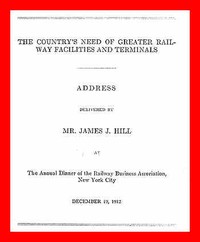
The Country's Need of Greater Railway Facilities and Terminals Address Delivered at the Annual Dinner of the Railway Business Association, New York City, December 19, 1912 — Edition Insights
16
4
Project Gutenberg
2014
Railroad stations -- United States; Railroads -- United States -- Finance
Readers of public-domain and historical texts
Project Gutenberg digital edition
en
Edition facts
Words: 10,480
Reading time: 46 min
Text sections: 2
Source:
Project Gutenberg record #47536
James J. Hill's 1912 address to the Railway Business Association argues that expanding terminal facilities is critical to preventing traffic congestion and economic stagnation, using concrete data and a bottle-neck analogy to frame the issue.
Editorial Edition Score
4.4/5
★★★★★
★★★★★
Calculated from edition completeness, EPUB availability, text structure and catalogue metadata. Not a user rating.
Edition quality
James J. Hill opens his 1912 address with a bottle-neck analogy: increasing the size of a bottle without enlarging the neck makes filling and emptying slower. This image frames his central argument that expanding terminal facilities, not merely adding track, is the pressing need for American railroads. Drawing on his experience as a railway builder, Hill grounds his case in specific figures—such as Pittsburgh District tonnage rising from 64,125,000 to 152,000,000 between 1901 and 1911—and warns that without action, congestion will become chronic.
The Bottle-Neck Problem
Hill’s opening metaphor—the bottle and its neck—is not decorative but structural. He argues that the transportation system has grown in volume without proportional expansion at terminals, creating a physical choke point. The 1907 traffic block, which took months to clear, is cited as evidence. Hill attributes the eventual relief partly to a panic that reduced business volume, not to systemic improvement. He insists that efficiency gains alone cannot keep pace with population and production growth, and he supports this with a decade of Pittsburgh tonnage data. The language is direct and quantitative, avoiding abstract theory.
Voluntary Rate Reductions and Their Cost
Hill counters the notion that rate reductions were forced by legislation. He points to voluntary cuts on staple products, which he claims enabled settlement and doubled production. Using Great Northern Railway figures, he calculates that if 1881 rates had remained unchanged through 1910, the public would have paid $1,267,411,954 more—over eight times the average par value of outstanding stock and bonds. He extends this nationally: if rates had risen with commodity prices and wages between 1894 and 1909, the transportation bill would have been seven billion dollars higher. These numbers serve as evidence of the railroads’ self-restraint.
The Financial Impasse
Hill presents a financial paradox: railroads must expand terminals to move traffic, but expansion requires capital, which requires earnings, which are constrained by rate regulation. He describes a “financial ‘no thoroughfare’” where investors will not lend without assurance of fair returns. The tone is urgent, almost exasperated, as he argues that rigid prohibition of rate advances blocks necessary growth. He does not propose a specific policy but frames the problem as a systemic deadlock that demands relaxation of hostile regulation.
Comparative Labor and Tariff Context
Hill situates the railroad debate within broader economic policy. He notes that U.S. import duties averaged 41.22% in 1911, ostensibly to protect American labor. He then compares railway wages: in 1910, U.S. employees earned more than twice their U.K. counterparts and nearly three times those on the Prussian-Hesse system. This comparison serves to argue that cheap transportation has not come at labor’s expense. The address thus weaves together tariff policy, labor costs, and infrastructure needs, presenting railroads as both efficient and fair employers.
Hill’s address is a data-driven argument from an industry insider, not a neutral overview. Readers should attend to how he uses numbers—tonnage, wage comparisons, hypothetical savings—to build credibility and urgency. His bottle-neck metaphor and financial impasse framing reveal a speaker convinced that the problem is physical and regulatory, not a failure of management. The speech offers a window into early twentieth-century debates about infrastructure, regulation, and economic growth.
Reader reflection
Take a moment to reflect on this book
Create a short personal record of your experience with this book.
Your progress
0
/
10
2
Was reading this book enjoyable?
3
How likely are you to recommend this book?
4
How much effort did this book require?
5
Did any part of the book feel personally relevant?
6
Which element worked best for you?
7
How strongly did the book affect you emotionally?
8
Could you apply anything you learned?
9
What is the main idea you are taking away?
10