1

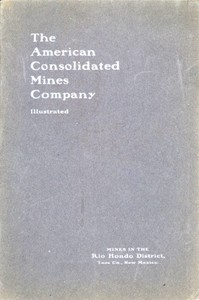
The American Consolidated Mines Company (1903) — Themes and Context
4
1
Project Gutenberg
2019
Prospectuses; American Consolidated Mines Company; Mines and mineral resources -- New Mexico -- Taos County
Readers of public-domain and historical texts
Project Gutenberg digital edition
en
Edition facts
Words: 6,907
Reading time: 31 min
Text sections: 1
Source:
Project Gutenberg record #60691
An editorial note on the 1903 prospectus for The American Consolidated Mines Company, examining its promotional language, rhetorical shifts, and the interplay of financial promise and regional history in the Rio Hondo district.
Editorial Edition Score
4.4/5
★★★★★
★★★★★
Calculated from edition completeness, EPUB availability, text structure and catalogue metadata. Not a user rating.
Edition quality
The American Consolidated Mines Company (1903) is not a conventional corporate report but a prospectus designed to attract investors to gold, silver, and copper claims in New Mexico's Rio Hondo district. Its language oscillates between defensive justification and exuberant promise, reflecting the tensions of early twentieth-century mining promotion. The document opens by addressing skepticism head-on, acknowledging that 'the unscrupulous promoter has been too much in evidence' before pivoting to assert that mining 'is just as legitimate and far more profitable than any other enterprise.' This rhetorical strategy—conceding doubt to build credibility—permeates the text.
Defensive Openings and Shifting Authority
The prospectus begins with a historical apology: Spanish and Mexican land grant controversies 'have greatly retarded the development' of mineral lands. By framing legal resolution as a recent breakthrough, the document positions itself at a propitious moment. Yet the voice quickly shifts from explanatory to promotional, claiming 'almost inexhaustible bodies of good paying gold, silver and copper ore.' The phrase 'without any exaggeration' ironically signals that exaggeration is anticipated. The text then borrows authority from the past, noting that in 1680 the same mountains 'gave up millions in gold and silver to the Spaniards, although worked by the crudest possible methods.' This appeal to historical precedent is a recurring tactic, used to imply that modern methods will yield even greater returns.
The Rhetoric of Certainty and the Investor's Burden
The document repeatedly insists on the safety and profitability of mining, contrasting it with other enterprises. 'Mining is not affected by seasons or stagnant markets,' it declares, while farming and manufacturing are subject to 'competition, over-stocked market, variations in the price of raw material.' This binary simplifies complex economic realities into a clear choice for the reader. The text also shifts responsibility to the investor: 'the investor must exercise care and judgment if he would make his investments profitable.' Such statements serve a dual purpose—they flatter the reader's discernment while deflecting potential criticism. The inclusion of a quotation from The New York Herald further bolsters credibility, citing 'influential business men' and claiming that 'eighteen to twenty per cent per annum is not considered a hazardous western profit.'
Structural Details and the Illusion of Transparency
The prospectus is rich with concrete figures: 3,000,000 shares at one cent par value, $2,000 cash in treasury at organization, and later $11,866.82. These numbers create an impression of precision and openness. Yet the document omits key information, such as the current market price of stock or any independent assay results. The list of officers and directors—J. Shumaker, O. H. Stanley, C. D. Weimer—and endorsements from a U.S. District Attorney and ex-Senator lend an air of legitimacy. The repeated mention of 'non-assessable' stock and 'no future liabilities' directly addresses investor fears. The closing invitation to 'address, C. D. Weimer, Secretary-Treasurer, Minerva, Ohio' grounds the document in a specific, small-town location, contrasting with the grand claims of western mineral wealth.
Readers should approach this prospectus as a primary source in the history of American mining promotion. Its blend of defensive rhetoric, historical allusion, and selective financial data reveals how turn-of-the-century companies sought to overcome investor skepticism. The document's value lies not in the accuracy of its claims but in its demonstration of persuasive strategies that remain familiar in investment literature today.
Reader reflection
Record your reading impressions
A brief reflection can help important ideas stay with you longer.
Your progress
0
/
10
2
Was reading this book enjoyable?
3
How likely are you to recommend this book?
4
Did the language feel accessible?
5
How clearly were the main ideas presented?
6
How did the pace of the book feel?
7
Did you gain anything practical from the text?
8
Which aspect of the book did you value most?
9
What is the main idea you are taking away?
10