
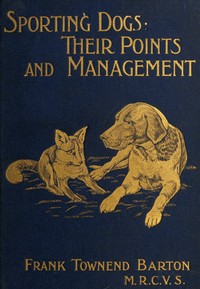
Sporting Dogs: Their Points and Management in Health and Disease by Barton
Forget novels for a moment. 'Sporting Dogs: Their Points and Management in Health and Disease' is a different kind of book. Written by Frank Townend Barton and published in the early 1900s, it's a practical guide. It was the go-to manual for gentlemen who owned gun dogs—pointers, setters, retrievers, and spaniels.
The Story
There isn't a traditional plot. Instead, the book is split into two clear parts. The first half is all about 'Points.' Barton describes, in meticulous detail, the perfect physical form for each type of sporting dog. He talks about skull shape, ear placement, rib spring, and tail carriage. He explains what makes a dog beautiful, but more importantly, what makes it efficient and enduring in the field. The second half is 'Management.' This is where it gets really practical (and sometimes startling to a modern reader). Barton provides advice on kennel building, feeding, breeding, and training. Then, he dedicates large sections to canine diseases and their treatments, listing symptoms and prescribing remedies common in his time.
Why You Should Read It
You should read this not for a story, but for a perspective. It's a direct line to the mind of a dedicated dog man from over a hundred years ago. His passion for the animals is obvious, even if some of his methods are outdated. Reading his precise descriptions of the 'ideal' dog shows how early the standards for breeds were being cemented. The medical sections are a historical record, reminding us how far veterinary science has come. It’s humbling and fascinating. You come away with a deep appreciation for the timeless bond between humans and working dogs, and a real sense of how much care and thought has always gone into their stewardship.
Final Verdict
This book is a niche treasure. It's perfect for history buffs, dog breed enthusiasts, and anyone involved in field sports who wants to understand the roots of their tradition. It's also great for the casually curious reader who enjoys primary source material—it feels authentic. If you're looking for a warm narrative about a boy and his dog, this isn't it. But if you want to spend a few hours in the boots of an Edwardian gamekeeper, learning his craft and seeing the world through his eyes, this book is a completely unique and absorbing experience.
This digital edition is based on a public domain text. Access is open to everyone around the world.
David Rodriguez
1 year agoHaving read the author's previous works, the chapter on advanced strategies offers insights I haven't seen elsewhere. This is a solid reference for both beginners and experts.
Charles Gonzalez
1 year agoIt’s rare to find such a well-structured narrative nowadays, the visual layout and supporting data make the reading experience very smooth. This exceeded my expectations in almost every way.
Robert Miller
6 months agoCompatible with my e-reader, thanks.






Nancy Jackson
6 months agoGreat value and very well written.