
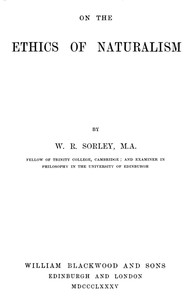
On the Ethics of Naturalism by W. R. Sorley
Let's be clear from the start: this isn't a novel with a plot. Think of it as a rigorous, patient argument. W.R. Sorley, a Scottish philosopher, is responding to the rising tide of 'naturalism' in the late 1800s—the idea that only the natural world and its laws are real. His book systematically examines this worldview, especially as it applies to human ethics.
The Story
The 'story' here is the clash of two big ideas. On one side is naturalism, which says everything about us, including our minds and morals, can be fully explained by physical causes and evolution. On the other side is Sorley's conviction that this view is incomplete. He walks us through the logic. If our sense of right and wrong is just a product of natural selection, meant to help our species survive, then is it truly 'good' in any meaningful sense? Or is it just useful? Sorley believes real moral obligation—the 'ought'—can't be squeezed out of mere descriptions of what 'is' in nature. The book is his careful, step-by-step case for why ethics needs a foundation that naturalism can't provide.
Why You Should Read It
I'll be honest, the writing is dense and from another time. But the core question hooked me. In our age of neuroscience and evolutionary psychology, we still grapple with this: Are we just complex machines? Sorley insists we are more. Reading him feels like finding a clear, reasoned voice in a noisy debate. He doesn't dismiss science; he challenges us to see its limits when it comes to human value. His defense of moral freedom and conscience against purely mechanical explanations is intellectually bracing. It made me pause and really think about what I believe makes an action truly good, beyond social conditioning or biology.
Final Verdict
This book is for the thoughtful reader who enjoys deep dives into big questions. It's perfect for philosophy fans, students of intellectual history, or anyone who's felt uneasy about overly reductionist explanations of human life. It's not for someone looking for a casual weekend read. But if you want to engage with a classic, well-structured argument about meaning, morality, and science, Sorley's work remains a powerful and relevant challenge. It's a book that doesn't give easy answers but sharpens your questions.
This publication is available for unrestricted use. Use this text in your own projects freely.
Elizabeth White
4 months agoHaving read the author's previous works, the emphasis on ethics and sustainability within the topic is commendable. Truly a masterpiece of digital educational material.
Elizabeth Anderson
1 year agoGiven the current trends in this field, the case studies and practical examples provided add immense value. I'm genuinely impressed by the quality of this digital edition.
Donald Lee
2 years agoThe author provides a very nuanced critique of current methodologies.
Thomas Lopez
2 months agoUnlike many other resources I've purchased before, the argument presented in the middle section is particularly compelling. I’ll definitely be revisiting some of these chapters again soon.



Robert Perez
9 months agoI appreciate how this edition approaches the core problem, the chapter on advanced strategies offers insights I haven't seen elsewhere. It cleared up a lot of the confusion I had previously.