1

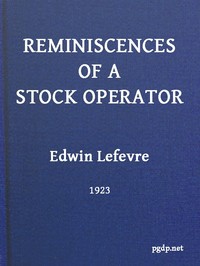
Reminiscences of a Stock Operator — Themes and Context
9
2
Project Gutenberg
2019
Speculation; New York Stock Exchange; Investments
Readers of public-domain and historical texts
Project Gutenberg digital edition
en
Edition facts
Words: 114,585
Reading time: 499 min
Text sections: 27
Source:
Project Gutenberg record #60979
Edwin Lefevre's fictionalized memoir of a stock trader, based on Jesse Livermore, examines the psychology of speculation through the narrator's early career, from board boy to seasoned operator, focusing on price behavior and trading discipline.
Editorial Edition Score
4.9/5
★★★★★
★★★★★
Calculated from edition completeness, EPUB availability, text structure and catalogue metadata. Not a user rating.
Edition quality
From the opening pages, the narrator of Reminiscences of a Stock Operator presents himself as a boy who sees stock prices not as dollars but as numbers—pure data that change. This detachment from money is the first clue to the authorial choices that shape the book: Lefevre builds a voice that is analytical, retrospective, and relentlessly focused on the mechanics of trading. The narrator’s early job posting prices on a board trains him to memorize price movements, and he soon notices that stocks “were apt to show certain habits.” The language is plain, almost clinical, but it carries the weight of hard-won experience.
Numbers Before Meaning
The narrator’s early fascination is with the behavior of prices, not their causes. He writes, “I simply saw that they changed. That was all I had to think about.” This reduction of the market to patterns—what he calls “parallel cases” and “precedents”—is a deliberate stylistic choice. Lefevre avoids financial jargon or dramatic metaphors; instead, the prose mirrors the trader’s mind: concrete, repetitive, and obsessed with sequence. The narrator carries “dope sheets” in his memory, testing past performances against present ticks. The diction stays grounded in observation: “I noticed,” “I found myself testing,” “I looked for.” There is no talk of greed or fear yet—only the cold logic of numbers.
The Voice of Defeat and Recovery
When the narrator loses his stake and leaves New York, the tone shifts to a weary pragmatism. He says he was “worse than broke, since I owed over one hundred thousand dollars.” The admission is flat, unembellished. Lefevre’s narrator does not wallow; he reports. The journey to Chicago and the mysterious summons from Lucius Tucker introduce a new element: the trader as a man others seek out. The dialogue with Tucker is clipped, full of refusals to explain: “No,” “Can’t you write me?” “No.” This verbal economy reinforces the narrator’s own discipline—and the book’s insistence that trading is a solitary, secretive craft. The return to New York is framed not as a triumphant comeback but as a “curious experience,” keeping the reader uncertain.
The Texture of the Trading Floor
Lefevre’s descriptions of brokerage offices and ticker tape are sparse but precise. The office has a “big board in the customers’ room,” a ticker, and customers who “called out the prices.” The narrator works from ten to three, too busy to talk. These details create a sensory backdrop: the noise, the speed, the constant change. The author avoids romanticizing the setting; it is a workplace, not a casino. The narrator’s memory for figures is his only tool. When he later trades in Chicago “very conservatively,” the phrase signals a hard-learned caution. The prose never inflates the drama—the market’s excitement is implied through the narrator’s focus, not through exclamation or hyperbole.
Dialogue as a Window into Character
The exchange with Lucius Tucker reveals how Lefevre uses dialogue to convey trust, mystery, and the trader’s wariness. Tucker’s insistence that the narrator come to New York is met with resistance: “Is this a fool trip?” The narrator demands clarity, but Tucker withholds it, saying “It wouldn’t be fair to him.” The back-and-forth is terse, each line a short volley. This style reflects the narrator’s own trading discipline: he wants facts, not promises. When he finally agrees, he does so because he knows Tucker is “friendly.” The dialogue does not explain the plot; it shows the narrator’s decision-making process. Lefevre lets the reader infer the tension from what is left unsaid.
Readers approaching Reminiscences of a Stock Operator should attend to the narrator’s voice: it is the book’s true subject. Lefevre’s choices in diction—short sentences, concrete nouns, a refusal to moralize—create a portrait of a mind trained by the market. The excerpts offer no grand theory of speculation, only the incremental wisdom of a man who watched prices change. Treat the book as a case study in how a trader thinks, not as a manual or a thriller.
Reader reflection
Before you leave, reflect on the book
Use these questions to collect your thoughts before moving on.
Your progress
0
/
10
2
Was reading this book enjoyable?
3
Would you encourage someone else to read it?
4
What was the reading difficulty like?
5
How strongly did the book affect you emotionally?
6
Would you start a conversation about this book?
7
How well did it match your expectations?
8
Is this a title worth rereading?
9
What did this book teach you most?
10