1

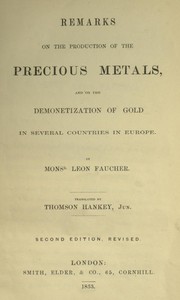
Remarks on the production of the precious metals and on the demonetization of gold in several countries in Europe — Reading Companion
4
1
Project Gutenberg
2015
Precious metals; Precious metals -- Europe; Bimetallism
Readers of public-domain and historical texts
Project Gutenberg digital edition
en
Edition facts
Words: 27,727
Reading time: 121 min
Text sections: 5
Source:
Project Gutenberg record #50581
Léon Faucher's 1853 treatise on gold production and demonetization, translated by Thomson Hankey, examines early Australian gold rushes and European monetary policy. The text opens with a translator's preface that questions Faucher's conclusions, then moves through detailed accounts of mining operations and economic arguments.
Editorial Edition Score
4.6/5
★★★★★
★★★★★
Calculated from edition completeness, EPUB availability, text structure and catalogue metadata. Not a user rating.
Edition quality
The translator's preface immediately signals that this is not a neutral document. Thomson Hankey, writing to Faucher, expresses doubt about the author's central thesis—that the Australian gold discoveries would not cause significant depreciation. Hankey notes that recent reports estimate £8,000,000 in gold shipped from Australia in 1852, and he warns that sovereigns shipped there may soon return, flooding the market. This prefatory tension frames the entire work: Faucher's analytical calm is set against Hankey's palpable alarm.
The main text then shifts to a vivid, almost journalistic account of the early Australian gold rushes. Faucher describes the 'wild spirit of speculation' that followed the government's announcement of mining licenses, and he traces the spread of gold fever from Ophir to the Turon River, where miners found nuggets weighing up to 28 pounds. The prose is energetic, drawing on newspaper reports and eyewitness testimony.
A Translator's Skepticism
The volume opens with a letter from translator Thomson Hankey to the author, Léon Faucher. Hankey explains that he first read Faucher's remarks in the Revue des Deux Mondes and later in the reports of the Académie des Sciences Morales et Politiques. He then immediately challenges Faucher's conclusions. Hankey cites a recent visitor from Victoria who claimed the Bathurst diggings were nearly exhausted, yet he also notes that production elsewhere in Australia was rising. His core disagreement is blunt: 'I can hardly agree with you, that there is so little ground for alarm as to a depreciation in the value of gold.' This prefatory debate sets up the reader to approach Faucher's subsequent analysis with a critical eye, aware that even the translator found the author's optimism questionable.
Gold Fever in New South Wales
Faucher's narrative of the Australian gold discoveries is rich in specific detail. He describes how the colonial government claimed all gold discoveries as Crown property and set a license fee of 30 shillings per miner per month. The rush that followed was chaotic: 'From the Bay of Newton to the Gulph of St. Vincent, over an extent of 2,000 miles of shore, there was no town or village without its sought-for neighbouring placers.' The first major site, Ophir, was soon overshadowed by the Turon River, where gold was found not just in scales but in pépites or nuggets. Faucher notes that while Ophir diggers earned 15 to 20 shillings a day, Turon miners counted their gains by ounces. The shift from simple washing to amalgamation marked a more systematic approach.
The Weight of Nuggets and the Spread of Mania
Faucher provides precise figures that ground his account in observable fact. In mid-July, Doctor Ker found a quartz lump weighing 3 hundredweight containing more than 100 pounds of gold. Later, three nuggets each weighed 26 to 28 pounds. By August, the first gold dust shipments to England totaled £50,000, and the Turon and Mount Ophir washings were producing £10,000 to £12,000 per week. The psychological impact was immense: Faucher quotes the Morning Herald of Sydney at length, a passage that predicts astonishment 'from the queen on the throne to the peasant in the fields.' The newspaper's hyperbolic language—'population and wealth will rush to Australia like a torrent'—illustrates how media frenzy amplified the gold rush's economic and social effects.
Economic Argument Amidst Descriptive Detail
Though the excerpts focus on the Australian gold rush, Faucher's larger purpose is economic analysis. The catalog subjects—precious metals, bimetallism, and demonetization—indicate that he is building a case about the global monetary system. The descriptive passages serve as evidence for his argument that the initial gold discoveries were not a reliable basis for long-term predictions. He notes that the first gatherings 'cannot fairly be assumed as data on which to found estimates of future production.' This cautionary note, placed within a vivid narrative of discovery and speculation, gives the reader a concrete sense of the data Faucher is working with. The tension between the excitement of the gold fields and the sober economic reasoning is the work's central dynamic.
Readers approaching this text should attend to the interplay between Faucher's analytical framework and the raw material of the gold rush reports. The translator's preface offers a useful entry point, as it highlights the very debate the book seeks to address. The descriptive sections are not mere background; they are the evidence from which Faucher draws his conclusions. By tracing how specific nugget weights, license fees, and newspaper quotations are woven into economic reasoning, a first-time reader can appreciate the work as both a historical document and a piece of monetary theory.
Reader reflection
Before you leave, reflect on the book
Use these questions to collect your thoughts before moving on.
Your progress
0
/
10
2
Was reading this book enjoyable?
3
How likely are you to recommend this book?
4
How demanding did the text feel?
5
How would you rate its originality?
6
Was the book easy to understand?
7
Did this book create an emotional response?
8
Was the book moving at the right speed?
9
What changed or sharpened your thinking?
10