1

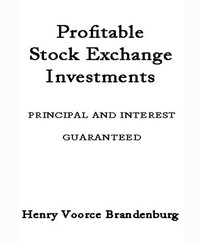
Profitable Stock Exchange Investments — Key Ideas to Explore
7
2
Project Gutenberg
2013
Speculation; Investments
Readers of public-domain and historical texts
Project Gutenberg digital edition
en
Edition facts
Words: 10,490
Reading time: 46 min
Text sections: 2
Source:
Project Gutenberg record #44052
A 1901 investment manual by Henry Voorce Brandenburg & Co. arguing that stock market profits come from capital, patience, and method—not luck. Distinguishes investment from speculation, defines Wall Street jargon, and promotes the firm's conservative strategies.
Editorial Edition Score
4.4/5
★★★★★
★★★★★
Calculated from edition completeness, EPUB availability, text structure and catalogue metadata. Not a user rating.
Edition quality
From its opening pages, Profitable Stock Exchange Investments presents itself as a corrective to popular narratives of Wall Street as a den of thieves. The authors assert that money is never lost in the Street—it merely changes hands, and those who lose are gamblers operating on margin without adequate capital. The book’s central claim is that success follows a simple, repeatable method: buy good dividend-paying stocks when they are low, sell when they are high, and have the patience and capital to wait for the right moments.
Published in 1901 by Henry Voorce Brandenburg & Co., a New York banking firm, the text blends promotional material for the company’s services with a glossary of trading terms and a sustained argument against speculation. The excerpts reveal a work that is part instructional manual, part advertisement, and part defense of Wall Street as a legitimate arena for conservative investment.
Investment vs. Speculation: A Firm Distinction
The book draws a sharp line between investment and speculation, a distinction central to its argument. Speculation is defined as buying on margin—gambling with borrowed money and inadequate capital—which the authors say ought to lose. Investment, by contrast, means buying shares of sound, stable corporations with cash, holding them through fluctuations, and selling only when prices rise. The authors insist this is no more gambling than any legitimate business, where one buys low and sells high.
This binary is reinforced by the glossary entries for terms like “squall,” “slump,” and “panic,” which are described as disastrous for margin traders but as the best opportunities for the well-capitalized investor. The text repeatedly frames market downturns as “bargain days” for those with patience and funds. The firm’s own method, it claims, exploits these very conditions.
The Glossary as a Window into Market Culture
A substantial portion of the excerpts consists of a glossary defining Wall Street slang circa 1901. Terms like “pointer,” “pool,” “corner,” “put,” and “call” are explained with a mix of technical precision and moral commentary. For instance, a “pointer” is described as an inside tip that is “more than likely to be an unfounded, silly rumor,” yet the authors concede it may prove valuable if the source is reliable and the recipient has capital to invest—not speculate—on narrow margin.
The glossary also reveals the book’s dual audience: it educates novices while promoting the firm’s expertise. Definitions of “insiders” distinguish between true insiders (corporate officials who never leak information) and those who only pretend to be. This taxonomy serves to position Brandenburg & Co. as knowledgeable operators who understand the real dynamics of the market, as opposed to the rumor-mongers and gamblers who populate the popular imagination.
The Firm’s Self-Promotion as Investment Philosophy
Throughout the excerpts, the book functions as an extended advertisement for Henry Voorbee Brandenburg & Co. The preface states that the purpose is to inform readers of methods used by successful operators—methods the firm itself employs. The text promises to give the public an opportunity to invest safely and profitably through the company, which will handle funds according to “correct and profitable methods.”
This promotional thread is woven into the investment advice. The glossary entry for “pointer” includes a conditional endorsement: if the tip comes from a reliable party and the investor has enough capital to hold on “after the methods of this company,” it may prove good. Similarly, the description of panics as opportunities for profit is immediately tied to the firm’s ability to buy securities at low prices. The book thus presents its investment philosophy as inseparable from its business model, making it a primary source for understanding early twentieth-century financial marketing.
Readers approaching this text should keep in mind its dual nature: it is both a practical guide to stock market investing and a promotional document for a specific firm. The glossary offers a valuable snapshot of early 1900s financial jargon, while the repeated emphasis on capital and patience reflects a conservative investment philosophy that contrasts sharply with the speculation the book condemns. The excerpts do not reveal whether the firm’s methods succeeded, but they provide a clear picture of how one Wall Street institution sought to attract clients by positioning itself as the antidote to gambling.
Reader reflection
How will you remember this book?
Save your reaction, strongest insight, and memorable passage.
Your progress
0
/
10
2
How much did you enjoy the reading experience?
3
How likely are you to recommend this book?
4
How easy was the book to follow?
5
Would a second reading be valuable?
6
Would you like to discuss this book with someone?
7
How distinctive were its ideas or approach?
8
How understandable was the text?
9
What changed or sharpened your thinking?
10