1

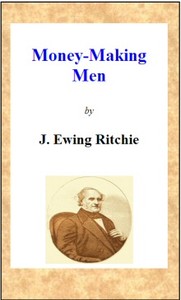
Money-making men; or, how to grow rich — Reading Companion
5
1
Project Gutenberg
2020
Rich people -- Biography
Readers of public-domain and historical texts
Project Gutenberg digital edition
en
Edition facts
Words: 80,503
Reading time: 351 min
Text sections: 7
Source:
Project Gutenberg record #62268
J. Ewing Ritchie's 1886 collection profiles self-made businessmen, from London publishers to Irish car-men, examining the habits, luck, and simple principles behind their fortunes through anecdotal, moralizing vignettes.
Editorial Edition Score
4.8/5
★★★★★
★★★★★
Calculated from edition completeness, EPUB availability, text structure and catalogue metadata. Not a user rating.
Edition quality
Ritchie opens with a blunt admission: City people are mercenary, and that is natural. The first chapter sets a tone of frank moralizing, mixing admiration for thrift with warnings against idleness. He cites a judge telling schoolboys that in England anyone can rise by worth, then immediately undercuts the sentiment with a story of a costermonger run over in the street, found to be worth hundreds of pounds—an accidental fortune that raises more questions than it answers. The narrative voice is conversational, peppered with asides and rhetorical questions, as if the author is thinking aloud. Ritchie does not pretend to offer a systematic guide; instead, he presents a gallery of examples, each illustrating some principle of accumulation, whether by luck, frugality, or a single-minded rule like Ricardo's observation that people exaggerate the importance of events.
Anecdotal Evidence and the Moral Compass
Ritchie builds his case not through abstract theory but through a string of biographical sketches, each compressed into a few paragraphs. The tone is that of a seasoned observer, fond of paradox: the poor costermonger who dies rich, the Jew who began selling pencils and died worth a million. He asks repeatedly, “How was it done?” and answers with a mix of homily and curiosity. The moral framework is explicit—honesty is the best policy, speculation is risky—but the examples often celebrate cunning and eccentricity. The story of Thomas Guy, founder of Guy's Hospital, is typical: Guy was so frugal he dined on an old newspaper, and when his servant-maid presumed to order street repairs without his permission, he broke off their engagement. Ritchie relates this with a dry, almost amused detachment, leaving the reader to weigh the cost of such parsimony.
The Rise of the Self-Made Publisher
A cluster of profiles in the chapter on money-making publishers reveals Ritchie's fascination with humble origins. Jacob Tonson started with £100 from his barber-surgeon father; Robert Dodsley began as a footman; Lackington, son of a drunken cobbler, sold pies in the street before opening a bookshop with £25. Ritchie lingers on the details of their economies: Lackington's motto “Small profits do great things,” his chariot emblazoned with the same phrase. The narrative voice shifts between admiration and a kind of statistical wonder—Lintott left his daughter £55,000, Guy left £219,499 for his hospital. These numbers are offered without comment, as if the sums themselves carry moral weight. The pacing is brisk, each life reduced to a few telling incidents: the broken engagement, the pie-boy's pre-eminence, the footman's fortune.
The Chambers Brothers and the Principle of Thrift
Ritchie devotes particular attention to the Chambers brothers of Edinburgh, William and Robert, whose story he traces from a fifty-shilling stock of books to a publishing empire. The narrative here slows, offering more family background: the father a weaver, the grandfather an elder, the grandmother a severe critic of sermons. Ritchie seems to relish the contrast between their provincial origins and their later success. He notes that Robert opened his first stall at sixteen, “with nothing but these and his yearnings for independence.” The phrase captures the blend of sentiment and hard fact that characterizes the whole book. Ritchie does not analyze the economic conditions that made such rises possible; he simply presents the sequence of pence-scraping and book-hoarding as a kind of natural history. The reader is left to infer the principles from the examples.
Ritchie's method is cumulative rather than analytical. Each chapter adds another portrait, another variation on the theme of making money, but the book never quite resolves into a single argument. Readers should approach it as a series of case studies in character, not as a manual. The interest lies in the details—the broken engagement, the motto on the chariot, the costermonger's hidden wealth—and in the voice of a Victorian moralist who is both impressed and uneasy with the single-minded pursuit of riches.
Reader reflection
What was your reading experience?
Capture what you thought, learned, and would like to remember.
Your progress
0
/
10
2
How much did you enjoy the reading experience?
3
Is this a title you would suggest to others?
4
What was the reading difficulty like?
5
How valuable was this book for your own interests?
6
How closely did the book connect with your experience?
7
How clear did the writing feel?
8
Which element worked best for you?
9
Which lesson or insight stayed with you?
10