1

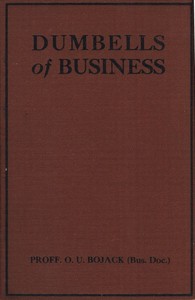
Dumbells of Business — Context and Discussion
18
4
Project Gutenberg
2015
Business
Readers of public-domain and historical texts
Project Gutenberg digital edition
en
Edition facts
Words: 38,641
Reading time: 169 min
Text sections: 6
Source:
Project Gutenberg record #48842
A satirical business manual from 1922, featuring 24 'Hot Sketches' that lampoon office archetypes like Mossbackitis and the Would-Be Sales Promoter, using exaggerated metaphors and mock-lessons to critique early 20th-century corporate culture.
Editorial Edition Score
4.7/5
★★★★★
★★★★★
Calculated from edition completeness, EPUB availability, text structure and catalogue metadata. Not a user rating.
Edition quality
Proff O. U. Bojack's Dumbells of Business opens with a dedication to 'all bedeviled brethern of the business world' and a promise of 'playful biffs on the beak of Business.' The 24 'Hot Sketches' that follow are less instructional than theatrical, each built around a named affliction—Mossbackitis, the Leaker, the Self Abnegationist—that turns corporate failings into comic types. The prose is deliberately overheated: a superintendent 'with his chew of Fine Cut tucked away in a back-cavity' presides over a plant passed down 'from Whiskers to Whiskers.'
The author, writing under a pseudonym and 'pruned of profanity' by Louis C. M. Reed, originally published these pieces in a house magazine called Auto Suggestions. The book's structure—short, self-contained sketches each ending with a 'Lesson for Today'—suggests a format designed for serialized reading, not systematic study.
Theatrical Archetypes and Invented Maladies
Each sketch introduces a character defined by a single flaw, given a mock-clinical label. 'The Plant Cured of Mossbackitis' personifies institutional inertia: the factory has been 'handed down from Whiskers to Whiskers without a break,' and the superintendent strokes his 'glazed Summit' while recounting its history. 'The Would-Be Sales Promoter' suffers from 'correspondence-schoolitis,' a condition that leads him to believe ignorance of sales is a qualification. These invented terms—Mossbackitis, Leaker, Self Abnegationist—function as shorthand for recognizable office types, turning abstract business problems into vivid, almost medical caricatures.
The naming strategy extends to the characters themselves: Slobbings, the Yob, the Picayune Planet. The effect is a bestiary of corporate dysfunction, where every failing has a label and a predictable outcome.
Domestic Tensions as Business Metaphors
Several sketches blur the line between office and home. In 'The Benedict Who Wisdomed-Up,' a married couple's arguments over driving—'she shifted her gears like a steam riveter,' 'he couldn't drive a nail'—mirror the friction of business negotiations. The car, a 'Home Breaker,' is sold to cover a business debt, and the lesson ('We don't know what we've got until we haven't got it any longer') applies equally to marriage and commerce.
This domestic framing suggests that the same patterns of stubbornness, miscommunication, and pride operate in both spheres. The sketches do not isolate business from life; they treat the office as a stage for universal human foibles, with the home serving as a parallel arena for the same struggles.
The Mock-Lesson as Structural Device
Every sketch ends with a 'Lesson for Today,' a one-sentence aphorism that undercuts the preceding narrative. The lessons are deliberately banal: 'We don't know what we've got until we haven't got it any longer' or, implicitly, that hiring a sales manager who 'knows nothing at all about the Selling Game' is a mistake. The gap between the elaborate, comic setup and the flat moral creates a satirical effect—the punchline is not wisdom but platitude.
This structure mimics the tone of earnest business advice literature while subverting it. The lessons are too simple to be useful, and the sketches too absurd to be taken literally. The reader is left to decide whether the author is mocking the reader's own search for easy answers or simply enjoying the incongruity.
Readers should approach Dumbells of Business as a period satire, not a practical guide. The exaggerated language and theatrical types reflect early 20th-century anxieties about efficiency, salesmanship, and corporate loyalty. The book rewards attention to its recurring motifs—the car as status symbol, the correspondence course as delusion, the 'Lesson for Today' as ironic closure. Because the excerpts are incomplete, the overall arc of the 24 sketches remains unclear, but the pattern of comic diagnosis is consistent throughout.
Reader reflection
Before you leave, reflect on the book
Use these questions to collect your thoughts before moving on.
Your progress
0
/
10
2
How did the book work for you overall?
3
Is this a title you would suggest to others?
4
How much effort did this book require?
5
Which part made the strongest impression?
6
Did it raise ideas you would like to talk about?
7
Did the book offer a fresh perspective?
8
Is this a title worth rereading?
9
What is the main idea you are taking away?
10