1

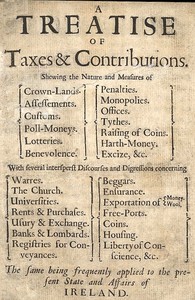
A Treatise of Taxes and Contributions Shewing the nature and measures of crown-lands, assessements, customs, poll-moneys, lotteries, benevolence, penalties, monopolies — A Reader’s Guide
4
1
Project Gutenberg
2020
Great Britain -- Politics and government -- 1660-1688; Finance -- Great Britain -- Early works to 1800; Taxation -- Great Britain -- Early works to 1800
Readers of public-domain and historical texts
Project Gutenberg digital edition
en
Edition facts
Words: 33,816
Reading time: 148 min
Text sections: 16
Source:
Project Gutenberg record #61588
Sir William Petty's 1662 treatise dissects taxation methods—crown-lands, customs, excise, poll-money—through economic reasoning and practical examples, with frequent application to Ireland's post-rebellion fiscal challenges.
Editorial Edition Score
4.7/5
★★★★★
★★★★★
Calculated from edition completeness, EPUB availability, text structure and catalogue metadata. Not a user rating.
Edition quality
Sir William Petty opens his 1662 treatise with a striking simile: he compares writing these sheets to a young man who, though not marrying solely to have children, nevertheless disposes of them as best he can. So Petty, having conceived these thoughts to clear his head of 'troublesome conceits,' now offers them to the public—specifically to Ireland, then under the Duke of Ormond's lord lieutenancy. The preface immediately grounds the work in a concrete problem: Ireland must maintain a large army to suppress future rebellions, which requires 'great and heavy Leavies upon a poor people and wasted Countrey.' Petty's stated aim is to help Ireland understand 'the nature and measure of Taxes and Contributions.'
Diction of Economic Calculation
Petty's language is relentlessly quantitative. He speaks of 'fifty millions of pounds per annum' as the nation's total expense, proposes a tonnage duty of '4. per Cent. or thereabouts,' and calculates that if only one in fifty exportations of money is seized, the smuggler's bribe of twenty shillings per fifty pounds adds 'two at least per cent.' to the cost of foreign goods. Numbers are not ornaments but the very substance of his argument. He treats economic problems as arithmetic ones: the 'part' that must be 'excinded out of the whole Consumption' to defray public charge. This numerical diction reflects a mind trained in political arithmetic, a field Petty helped found. Even when discussing prohibitions, he reduces them to percentages and surcharges, making the abstract tangible through calculation.
Voice of the Practical Reformer
Petty writes as a man who has seen administration up close. His voice is direct, sometimes impatient with received wisdom. He calls the prohibition on exporting money 'almost nugatory and vain' because it is 'almost impracticable.' He notes the 'great facility of smuckling by Briberies, Collusions, hiding and disguising of Commodities' despite oaths and penalties. His proposed remedies are concrete: instead of customs on goods, a simple tonnage on ships, 'collectible by a very few hands, as a matter visible to all the world.' He suggests turning customs into an 'Ensurance-præmium' so the king insures goods against sea and enemies, making the whole nation concerned in losses. This voice—skeptical of ineffective laws, pragmatic about human behavior—gives the treatise the feel of a policy memo rather than abstract theory.
Structure of Digression and Application
The treatise's structure is announced in its elaborate title: a list of taxes (Crown-Lands, Assessements, Customs, Poll-Moneys, Lotteries, Benevolence, Excize) followed by 'several intersperst Discourses and Digressions' on topics like Warres, Beggars, the Church, Universities, Usury, Banks, and even 'Liberty of Conscience.' Petty does not proceed in a linear fashion; he loops from customs to prohibitions to sumptuary laws, then back to tonnage. The digressions are not asides but integral to his method: each tax is examined not in isolation but in relation to broader economic and social conditions. The work is 'frequently applied to the present State and Affairs of IRELAND,' as the title page promises, making the structure itself a reflection of Petty's belief that fiscal theory must be tested against a specific, troubled locale.
Recurring Details of Enforcement and Evasion
Throughout the excerpts, Petty returns to the gap between law and practice. He observes that customs require 'the great number of Officers' and that smuggling thrives through 'Briberies, Collusions, hiding and disguising of Commodities.' Even after discovery, penalties can be 'mitigated and taken off.' The prohibition on exporting money, he argues, merely creates a market in bribes: 'twenty shillings be usually taken for conniving at fifty pounds.' These details reveal a writer acutely aware of administrative reality. He does not assume that a tax law will be obeyed; he calculates the cost of evasion and the inefficiency of enforcement. This attention to the human element—the officer who can be bribed, the merchant who will hide goods—gives the treatise a gritty specificity that distinguishes it from more abstract economic works of the period.
Petty's treatise rewards readers who attend to its numerical precision and its skeptical, reformist voice. The digressive structure may disorient those expecting a systematic textbook, but it mirrors the messy reality of seventeenth-century fiscal policy. For students of economic history, the work offers a window into how early political arithmeticians thought about taxation, enforcement, and the relationship between England and its often-troubled Irish dominion. Approach it as a series of interconnected policy proposals rather than a finished theory, and Petty's practical intelligence becomes clear.
Reader reflection
Record your reading impressions
A brief reflection can help important ideas stay with you longer.
Your progress
0
/
10
2
Did this book hold your interest?
3
Is this a title you would suggest to others?
4
Did the language feel accessible?
5
Is this a title worth rereading?
6
Was the book what you thought it would be?
7
What did you think about the pace?
8
Would you like to discuss this book with someone?
9
What changed or sharpened your thinking?
10