1

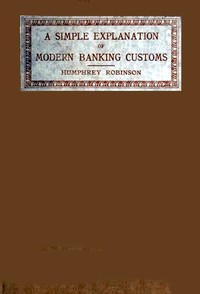
A Simple Explanation of Modern Banking Customs — Text and Context
4
1
Project Gutenberg
2013
Banks and banking
Readers of public-domain and historical texts
Project Gutenberg digital edition
en
Edition facts
Words: 16,762
Reading time: 73 min
Text sections: 2
Source:
Project Gutenberg record #43663
A 1909 guide by a banker turned author, explaining check clearing, note protesting, and collection procedures through concrete examples and warnings about common customer misunderstandings.
Editorial Edition Score
4.4/5
★★★★★
★★★★★
Calculated from edition completeness, EPUB availability, text structure and catalogue metadata. Not a user rating.
Edition quality
Humphrey Robinson, a banker with ten years of business experience before entering banking, writes this guide from the perspective of someone who once found banks baffling. He recalls his own “utter lack of comprehension” and the “mistakes, perplexity, and embarrassment” that followed. This personal admission sets the tone for a book that aims to demystify banking customs for depositors and new bankers alike, avoiding technical jargon wherever possible.
The opening chapter establishes a clear purpose: to foster “closer and more satisfactory relations” between the public and banks. Robinson’s voice is direct and occasionally self-deprecating, as when he notes the “unfairness and prejudice” with which he once judged banks. This framing suggests a work grounded in practical experience rather than abstract theory.
The Banker’s Own Confusion as a Starting Point
Robinson’s preface is unusual for a financial manual: he admits that for ten years he was “in business” and still found banks incomprehensible. He lists specific difficulties—choosing a bank, drawing a note correctly, calculating due dates, understanding protests and clearing houses—that he will address. This confession serves as a bridge to readers who may feel similarly intimidated. The author does not claim expertise from the start; instead, he builds credibility by acknowledging his former ignorance. The excerpts show that he returns to this theme later, reminding readers that “human nature” resists paying out money, especially for collection charges. By framing banking knowledge as something learned through error, Robinson invites readers to learn alongside him.
How the Clearing House Shapes Daily Banking
The clearing house is presented not as a mysterious institution but as a practical mechanism with a strict schedule. Robinson explains that banks must know by “clearing hour” whether checks are good; after that hour, they must either certify the check or hold it at their own risk. This rule explains why a bank cannot accept an out-of-town check in payment of a collection—it would take days to verify. The author repeatedly stresses that banks follow instructions from the sender of the paper, not the payer. He illustrates with a hypothetical: a St. Louis resident whose note has been sent through Bridgeport, Philadelphia, and back to St. Louis. The only way to recall the note is to reverse the chain of instructions. This concrete example makes the abstract process tangible.
The Local Collection Department: A Source of Friction
Robinson devotes a chapter to the Local Collection Department, calling it the recipient of “more complaints and unreasonable requests than any other department.” He notes that many customers resent paying “exchange” charges, but the bank merely follows the drawer’s instructions. The author’s tone is patient but firm: “Don’t feel resentment toward the bank when it asks you to pay for collection charges.” He reminds readers that the bank “cares nothing whether you, or the fellow at the other end, pays the cost.” This section also clarifies that a collecting bank cannot take instructions from anyone except the bank or person from whom it received the item. The emphasis on following instructions—and the legal constraints on banks—recurs throughout the excerpts, suggesting a central theme of the book.
Daily Workflow and the Pressure to Clear All Items
Robinson describes the end-of-day routine: tellers balance cash, bookkeepers take off balances, and all checks and drafts payable elsewhere must be listed and forwarded that same day. “Nothing can be held over without risk,” he writes, regardless of the workload. This passage reveals the operational urgency behind banking customs. The author’s insider knowledge—he worked in a “large city bank”—lends authority to these details. He also notes that banks must keep open during certain hours on business days, but after closing, a “tremendous amount of work” remains. By explaining the daily grind, Robinson humanizes the bank and its employees, reinforcing his goal of fostering better relations between depositors and bankers.
Robinson’s guide is best read as a series of practical lessons, each anchored to a specific banking procedure. Readers will benefit from following the examples closely, especially the multi-step collection scenario and the clearing house timeline. The author’s repeated emphasis on following instructions—and his warnings about the risks banks take—provides a framework for understanding why banks behave as they do. This is not a theoretical treatise but a working banker’s explanation, written for those who, like the author once was, find themselves perplexed by the customs of modern banking.
Reader reflection
Your personal reading reflection
Build a private reading journal entry for this title.
Your progress
0
/
10
2
Did this book hold your interest?
3
Would you encourage someone else to read it?
4
What was the reading difficulty like?
5
What was its emotional impact?
6
Did it raise ideas you would like to talk about?
7
Is this a title worth rereading?
8
What was the strongest part of the book?
9
What changed or sharpened your thinking?
10