1

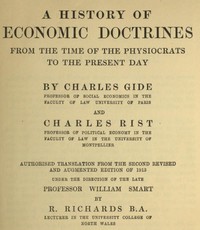
A history of economic doctrines — Background and Themes
5
1
Project Gutenberg
2018
Economics -- History
Readers of public-domain and historical texts
Project Gutenberg digital edition
en
Edition facts
Words: 325,189
Reading time: 1414 min
Text sections: 42
Source:
Project Gutenberg record #57500
This editorial note examines the narrative voice and shifts in pace in Gide and Rist's history of economic doctrines, focusing on how the authors balance exposition with critical commentary and how the translation preserves or alters the original's rhythm.
Editorial Edition Score
4.9/5
★★★★★
★★★★★
Calculated from edition completeness, EPUB availability, text structure and catalogue metadata. Not a user rating.
Edition quality
Gide and Rist's A History of Economic Doctrines moves between two distinct registers: a measured, almost judicial exposition of each school's tenets and a more animated, evaluative voice that judges their coherence and legacy. The translators, R. Richards and William Smart, preserve this duality, though the English syntax sometimes tightens the original French cadence. The work's pace is not uniform; it accelerates when the authors engage with contemporary debates—such as syndicalism—and slows to a deliberate crawl when dissecting the physiocrats' Tableau Économique.
Expository Calm and Critical Interruption
The opening chapters on the physiocrats and Adam Smith proceed with a steady, almost pedagogical rhythm. Sentences are long, clauses balanced, and the tone is one of patient explanation. Yet this calm is periodically broken by a sharp evaluative remark. For instance, after summarizing the physiocrats' doctrine, the authors note that 'the whole system rests on a metaphysical conception of the natural order'—a phrase that shifts from description to judgment. These interruptions are brief but frequent, creating a pattern of exposition followed by critique. The translators handle this by retaining the original's punctuation: dashes and semicolons signal the shift in register. In later sections on Marx, the critical interruptions become more extended, sometimes occupying whole paragraphs, which alters the rhythm from a steady flow to a staccato of assertion and rebuttal.
The Syndicalist Section: A Change in Tempo
The treatment of revolutionary syndicalism marks the most dramatic shift in pace. Here the prose becomes more urgent, with shorter sentences and repeated exclamatory structures: 'Strife is to be the keynote of the future,' and 'What is to be done when the worker just folds his arms?' The authors adopt a quasi-rhetorical style, posing questions and then answering them with vivid imagery—the general strike as a 'myth' that 'must give a very powerful stimulus to action.' This section reads less like a historical survey and more like a polemical pamphlet. The translators preserve this energy, though occasional British idioms ('going into raptures') may soften the original's edge. The change in tempo is not merely stylistic; it reflects the authors' own engagement with the subject, as they move from detached historian to engaged commentator.
The Prefatory Voice and Its Implications
The prefatory note, written by the translators, introduces a third voice: that of the English editors. It comments on the 'remarkable dearth of literature of this kind in English' and speculates on a 'territorial division of labour' in intellectual matters. This voice is more conversational and self-aware than Gide and Rist's, and it sets up an expectation of comparative analysis that the main text does not always fulfill. The note's pace is brisk, with short paragraphs and rhetorical questions ('Can it be that something like a “territorial division of labour” applies in matters intellectual as well as economic?'). This contrast between the translators' preface and the authors' opening chapters highlights the layered nature of the text: it is at once a French work, an English translation, and a contribution to a specific national debate about the study of economic thought.
Readers attentive to shifts in tone will find that Gide and Rist's history rewards careful pacing. The book is not a uniform chronicle but a series of engagements, each with its own rhythm. Noting where the authors accelerate—into critique, into contemporary relevance—offers a map of their intellectual priorities. The translation, while generally faithful, occasionally domesticates the original's sharper edges; comparing a few key passages with the French edition (if available) would illuminate how voice and pace are mediated across languages.
Reader reflection
What was your reading experience?
Capture what you thought, learned, and would like to remember.
Your progress
0
/
10
2
Did this book hold your interest?
3
Would you encourage someone else to read it?
4
How much effort did this book require?
5
How understandable was the text?
6
Did any part of the book feel personally relevant?
7
Could you apply anything you learned?
8
Did this book create an emotional response?
9
In one sentence, what did you learn?
10