1

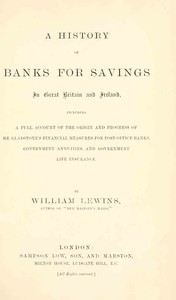
A History of Banks for Savings in Great Britain and Ireland — A Reader’s Guide
5
1
Project Gutenberg
2013
Savings banks -- Great Britain; Postal savings banks -- Great Britain
Readers of public-domain and historical texts
Project Gutenberg digital edition
en
Edition facts
Words: 142,463
Reading time: 620 min
Text sections: 16
Source:
Project Gutenberg record #42583
William Lewins traces the legislative and institutional history of savings banks in Great Britain and Ireland, from early philanthropic experiments to Gladstone's Post Office reforms, drawing on parliamentary records and case studies of fraud and mismanagement.
Editorial Edition Score
4.8/5
★★★★★
★★★★★
Calculated from edition completeness, EPUB availability, text structure and catalogue metadata. Not a user rating.
Edition quality
Lewins opens his history by distinguishing it from technical manuals: his book is meant for general readers and those interested in the social condition of the industrial classes, not for actuaries. He promises to speak in plain terms, avoid speculation, and give a full account of early savings banks alongside the parliamentary debates that reflected public feeling. The dedication to William Ewart Gladstone signals the political and financial weight of the subject.
A Self-Described Annalist
Lewins claims his work occupies ground not previously covered, noting that the only existing British book on savings banks—Mr. Scratchley's Practical Treatise—was technical. He positions himself as an annalist rather than a theorist, aiming to record rather than propose. This framing is consistent with his method: he relies heavily on parliamentary reports, committee evidence, and newspaper accounts. The preface sets expectations for a narrative driven by documented events rather than abstract principles.
The Voice of Parliamentary Evidence
Throughout the excerpts, Lewins weaves in testimony from Select Committees and individual witnesses. He quotes a manager who, after frauds were discovered, admitted he never compared ledgers with daily cash books, saying “there was the omission” and “that was where the link of investigation broke.” Such passages give the book a forensic quality. Lewins also cites the evidence of Mr. Edward Taylor, a Rochdale tradesman, as a key source for details of a bank fraud. The reader is constantly aware that the narrative is built from official inquiries.
Fraud as a Structural Problem
Lewins devotes considerable space to frauds, not as sensational anecdotes but as evidence of systemic weaknesses. He notes that in two separate banks, items of money were repeatedly entered in the books with nothing but a pencil. He also reports that after one failure, 17s. 6d. in the pound was freely offered for savings bank books in Rochdale. These details illustrate the gap between the ideal of thrift and the reality of mismanagement. Lewins refrains from cataloguing frauds outside savings banks proper, indicating a disciplined focus.
The Quaker Connection and Moral Economy
Lewins remarks on the Society of Friends' role in managing savings banks, praising their uprightness while noting that a few “black sheep” caused consternation. He observes that an “estimable sect of Christians” known for amassing wealth also took up bank management commendably. This blend of moral commentary and institutional history is typical of the book's tone: Lewins judges character but grounds his judgments in documented behavior. The reader sees how religious reputation and financial trustworthiness were intertwined in Victorian Britain.
Lewins writes for those who, as employers or by inclination, take an interest in the progress of the industrial classes. His book is best read as a documentary history, attentive to parliamentary procedure and local case studies. The reader should expect a narrative that moves between high-level policy and granular detail, always anchored in the evidence of committees, newspapers, and the words of those involved.
Reader reflection
How did this book work for you?
Your answers remain private and are stored only in this browser.
Your progress
0
/
10
2
What was your overall reaction to the book?
3
Would you pass this book on to a friend?
4
Did the language feel accessible?
5
Did anything about the book feel genuinely new?
6
How did the pace of the book feel?
7
How strong was your personal connection to the text?
8
What was the strongest part of the book?
9
What did this book teach you most?
10