1

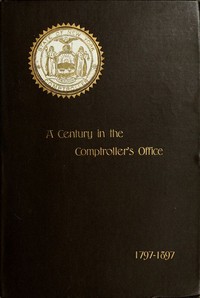
A Century in the Comptroller's Office, State of New York, 1797 to 1897 — Reading Notes
4
0
Project Gutenberg
2012
New York (State) -- Biography; New York (State). Comptroller's Office; Finance -- New York (State)
Readers of public-domain and historical texts
Project Gutenberg digital edition
en
Edition facts
Words: 17,644
Reading time: 77 min
Text sections: 3
Source:
Project Gutenberg record #40531
A centennial history of the New York State Comptroller's Office, written by the incumbent comptroller in 1897, profiling thirty officeholders and the office's evolving financial duties from 1797 to 1897.
The author, James A. Roberts, was the sitting comptroller when he compiled this centennial history, and he frames the work as a personal collection of facts gathered from "unsystematic reading and in the performance of his duties." The opening pages establish the office as a "unique feature" of state government, created in 1797 to resolve friction between the Treasurer and Auditor by combining the powers to audit and to pay. Roberts notes that thirty incumbents had produced a Vice-President, a President, four Governors, and two chief judges, signaling that the book will intertwine administrative history with political biography.
The Office as a Hybrid Institution
The first excerpt explains that the comptroller's role was broader than that of an auditor, encompassing duties of a state treasurer. Roberts traces colonial precedents back to 1680, showing that the office was a deliberate merger meant to end disputes over which bills to pay. The act creating it was drafted by Samuel Jones, a figure later connected to Samuel Jones Tilden. This institutional origin story sets up the book's dual focus: the legal evolution of the office and the individuals who shaped it.
Profiles of Civil War–Era Comptrollers
The middle excerpts concentrate on the 1860s, when the office managed wartime finances. Roberts describes Robert Denniston, a "gentleman farmer and Republican," who served during the war's first year and was praised for "wise and conservative" administration. Lucius Robinson, a Democrat elected on the Union ticket, oversaw a reduction of $8,000,000 in canal and general fund debts from 1860 to 1866 despite spending over $20,000,000 on military purposes. Roberts highlights Robinson's unsuccessful recommendation to pay bonded debt in specie, noting that Comptroller Flagg had done so during the 1837 suspension. These details reveal how the author uses specific financial decisions to illustrate each comptroller's judgment.
Recurring Patterns in Career Trajectories
Many comptrollers followed similar paths: service in the Assembly or Senate, then the comptrollership, then higher office. Sanford E. Church, for example, was a lawyer, Assemblyman, District Attorney, and Lieutenant-Governor before becoming comptroller, and later served as Chief Judge of the Court of Appeals. Roberts notes that Church's reports were "valuable State papers, expressed in clear, strong and forcible language." The book repeatedly ties a comptroller's prose style to their effectiveness, suggesting that Roberts values clear communication as a hallmark of competent administration.
The Author's Self-Awareness as Compiler
Roberts openly acknowledges the limits of his research, calling his sources "unsystematic reading." He does not claim completeness, but rather offers a collection of facts that seemed relevant to the office's centennial. This modesty shapes the book's tone: it is neither a formal history nor a memoir, but a hybrid that mixes biographical sketches, financial data, and institutional description. Readers should expect a work that prioritizes the comptrollers' public careers over private lives, and that occasionally leaps between decades without full narrative transition.
Roberts wrote this volume as a working official, not a professional historian, and the text reflects that perspective: it is strongest when detailing the mechanics of state finance and the political careers of the comptrollers. Readers interested in the administrative history of New York State will find a firsthand account of how the office evolved, while those seeking a broader social history will need to supplement this with other sources. The book's value lies in its specific, insider observations about the intersection of fiscal policy and political ambition.
Reader reflection
What did you think of this book?
Answer a few questions and save a private reflection on this device.
Your progress
0
/
10
2
How much did you enjoy the reading experience?
3
Would you recommend this book to another reader?
4
How demanding did the text feel?
5
How would you rate its originality?
6
Was the book what you thought it would be?
7
Is this a title worth rereading?
8
Was the book easy to understand?
9
What did this book teach you most?
10