1

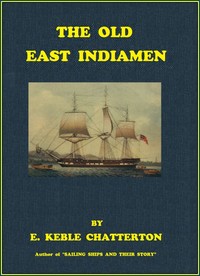
The Old East Indiamen — A Reader’s Guide
23
4
Project Gutenberg
2017
Merchant marine -- Great Britain; East India Company; Great Britain -- Commerce -- India; India -- Commerce -- Great Britain
Readers of public-domain and historical texts
Project Gutenberg digital edition
en
Edition facts
Words: 100,667
Reading time: 438 min
Text sections: 15
Source:
Project Gutenberg record #54561
Chatterton's account of East Indiamen uses logbook-style detail and firsthand accounts to trace the ships' design, crew life, and combat, from the Company's founding to the vessels' decline. The excerpts reveal a focus on practical seamanship and sudden violence, such as the Lord Eldon's fog-bound rescue and the Confiance's capture of the Kent.
Chatterton opens not with a sweeping history but with a close look at the Confiance, a French privateer whose black sides, French-cut sails, and red vane set her apart. Captain Eastwick’s description—'very square yards and jaunt masts, upright and without the smallest rake'—grounds the narrative in the tangible details of ship design. The author then pivots to the Lord Eldon incident, where a fog, a press-gang scare, and a beheading unfold in quick succession. This pairing of technical observation and sudden action establishes the book’s method: it moves between the builder’s craft and the mariner’s peril, never losing sight of the wooden hulls and the men who sailed them.
The Privateer’s Profile and the Merchantman’s Plight
The excerpt’s opening passage on the Confiance is a study in contrasts. Chatterton dwells on her appearance—'black sides with yellow moulding posts, and a French stern all black'—and her captain’s tactic of plying his crew with liquor before battle. The detail that she carried 'a red vane at her maintopgallant masthead' is the kind of specific, almost heraldic observation that recurs throughout. Against this sleek predator, the Kent is a lumbering target: the engagement leaves sixty of her crew killed or wounded. Yet the Kent is later retaken, and the Confiance herself captured, a reversal that Chatterton notes without moralizing. The numbers—£2,000,000 worth of shipping lost in a year—are allowed to speak for themselves.
Fog, Fear, and a Sword Stroke
The Lord Eldon episode is the most vivid set piece in the excerpts. Chatterton builds tension through a chain of misapprehensions: the crew mistakes the privateer for a King’s ship and hides to avoid impressment, leaving the vessel defenseless. The captain, below at the critical moment, emerges to find his ship taken. His response—calling to repel boarders, killing a Frenchman at the wheel 'with one stroke of the sword'—is presented as a matter-of-fact example of the Company’s fighting efficiency. The fog that enabled the attack also enables the escape, a neat symmetry that Chatterton lets stand without comment. The passage is notable for its restraint: the violence is stark but not sensationalized.
The Company’s Ships as Fighting Vessels
Throughout the excerpts, Chatterton emphasizes that East Indiamen were not passive merchantmen. The Lord Eldon’s crew, once rallied, drives off the boarders; the Kent’s loss is avenged by Company frigates. The author’s language is that of a naval historian: he speaks of 'offence and defence,' of ships that could 'overtake or sail away from' any vessel in those seas. Yet he also notes the human cost—the sixty casualties on the Kent, the French privateer’s losses—and the economic scale of the threat. The excerpts suggest that the book’s core argument is that the Company’s maritime strength was a matter of both design and discipline, not merely of cargo capacity.
Reading the Excerpts as a First-Time Navigator
A first reader encountering these excerpts should note how Chatterton uses specific ships as case studies rather than offering a continuous narrative. The Confiance and Lord Eldon are not the book’s main subjects; they are examples that illustrate broader points about ship design, crew behavior, and the hazards of the sea. The author’s voice is that of a knowledgeable sailor—he is a lieutenant in the R.N.V.R.—and he assumes a reader who can follow terms like 'maintopgallant masthead' and 'hove-to.' The excerpts do not reveal the book’s overall structure, but they suggest a work that moves from the general (the Company’s history, the route to the East) to the particular (individual voyages, battles, and ships).
These excerpts offer a narrow but revealing window into Chatterton’s method: he combines the eye of a ship-spotter with the instincts of a storyteller, favoring concrete detail over abstract analysis. A reader new to the subject will find the book more rewarding if they attend to the technical descriptions—the cut of a sail, the rake of a mast—as clues to the author’s larger argument about the seamanship that made the East India Company’s fleet formidable. The incidents of fog and boarding are not mere anecdotes; they are evidence for a thesis about discipline and surprise at sea.
Reader reflection
Take a moment to reflect on this book
Create a short personal record of your experience with this book.
Your progress
0
/
10
2
Was reading this book enjoyable?
3
Would you pass this book on to a friend?
4
Did the language feel accessible?
5
How closely did the book connect with your experience?
6
How understandable was the text?
7
Did this book create an emotional response?
8
Did you gain anything practical from the text?
9
What changed or sharpened your thinking?
10