
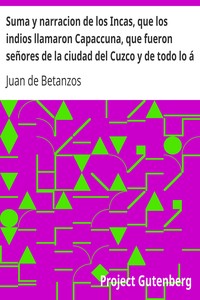
Suma y narracion de los Incas, que los indios llamaron Capaccuna, que fueron…
Okay, let's break this down. This isn't a novel with a plot in the usual sense. It's a 16th-century chronicle, but it reads like a foundational epic. Juan de Betanzos wrote it because the Spanish viceroy asked for a record of Inca customs and history. Betanzos, married to Doña Angelina Yupanqui (a former wife of Atahualpa!), was uniquely positioned to gather stories directly from the Inca nobility.
The Story
The book is structured as a history of the Inca rulers, the Capaccuna. It starts with their mythical origins emerging from the caves of Pacaritambo and follows the line of Sapa Incas—the divine kings. It details how each ruler expanded the empire, established laws, and built the infrastructure that made Tahuantinsuyo (the Inca Empire) so powerful. You get stories of conquest, engineering marvels like the road system, and the complex religious rituals. The narrative builds toward the civil war between Atahualpa and Huáscar, and finally, the arrival of the Spanish. Betanzos ends his account shortly after the conquest, with the Spanish establishing themselves in Cusco.
Why You Should Read It
This book is a time capsule. You're not getting a dry list of facts; you're hearing the Inca version of their own greatness, filtered through a sympathetic but still foreign scribe. The voice feels urgent, like the informants are trying to set the record straight before their world vanishes completely. You see their pride, their legal mind, and their view of the cosmos. What's most powerful is the glaring absence. The catastrophic violence of the conquest is often downplayed by Betanzos (or his sources), focusing instead on lineage and legitimacy. That silence speaks volumes. Reading it, you constantly grapple with the fact that this preservation effort is itself a product of the destruction.
Final Verdict
This is not a beach read. It's for the curious reader who wants to go beyond the simple 'conquistador' narrative. It's perfect for history buffs who like primary sources, for anyone fascinated by the Andes, or for people interested in how history gets written and by whom. You need some patience for the older writing style and the lists of names, but the payoff is immense: you feel like you're in the room, listening to the last generation of a free Inca nobility tell their story. Pair it with a modern history book for context, and it will completely change your understanding of this world.
This text is dedicated to the public domain. Feel free to use it for personal or commercial purposes.
Margaret Anderson
2 years agoExactly what I was looking for, thanks!
Emma Nguyen
6 months agoClear and concise.
Anthony Hill
1 year agoSimply put, the narrative structure is incredibly compelling. I couldn't put it down.

Richard Williams
7 months agoMy first impression was quite positive because the structural organization allows for quick referencing of key points. If you want to master this topic, start right here.