
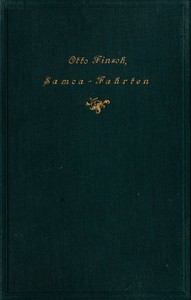
Samoafahrten by O. Finsch
Let's be clear from the start: 'Samoafahrten' ('Samoan Voyages') is not a novel. Published in 1888, it's the compiled travel account of German naturalist and ethnographer Otto Finsch, based on his journeys to the Pacific in the late 1870s and early 1880s. The 'plot' is the journey itself. We follow Finsch as he sails from island to island, with Samoa as his focal point. He describes landing on beaches, being received by local leaders, and trekking into the interior. The narrative is driven by his mission to observe, collect, and document everything—from the mating habits of exotic birds to the architectural details of a Samoan house (fale), and the intricate social customs he witnesses.
The Story
The story is Finsch's day-to-day experience. One day he's meticulously sketching a rare parrot, the next he's trying to navigate complex political discussions between different Samoan factions. He gets frustrated by bad weather that delays his collecting, and he's in awe of the skill of Samoan sailors. There's no single villain or hero; instead, the central 'character' is the Samoan culture itself, and the 'conflict' is the subtle, often unspoken pressure of the outside world beginning to make itself felt. Finsch is both an admirer and an agent of that change, collecting cultural artifacts as avidly as he does biological specimens.
Why You Should Read It
You read this for the immersive, firsthand perspective. Finsch's writing drops you right on the deck of a schooner or in the middle of a village ceremony. His descriptions of the landscape are so vivid you can almost feel the humidity. But the real value—and the challenge—is in his viewpoint. This isn't a modern, culturally sensitive travelogue. Finsch is a product of his time, and his observations are filtered through a 19th-century European mindset. Reading him critically is part of the experience. You get the stunning beauty of Samoa through his eyes, but you also get the paternalism and the colonial gaze. It’s a book that makes you think about who gets to tell a place's story, and how that story is shaped.
Final Verdict
This book is perfect for history buffs and armchair explorers who want an uncensored source document. If you enjoyed the adventure of 'The Lost City of Z' but prefer real journals, or if you're fascinated by Pacific history and want to see the era just before formal colonialism took hold, Finsch's account is essential. It's not a light, easy beach read. It's a dense, detailed, and sometimes frustrating portal to another time. Come for the descriptions of a tropical paradise, but stay for the complex, uncomfortable, and utterly human record of a world in transition.
This masterpiece is free from copyright limitations. Knowledge should be free and accessible.






Dorothy Jones
5 months agoSolid story.